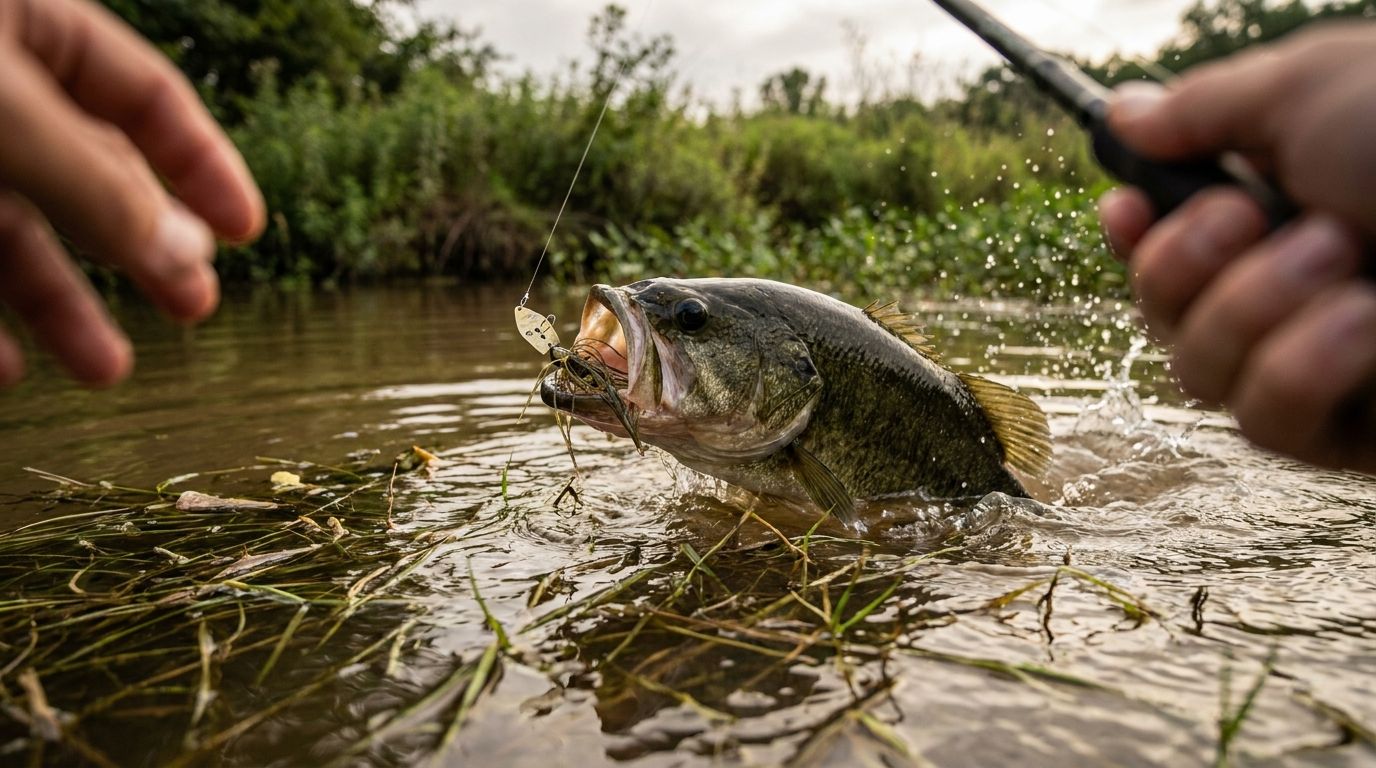
Why the Chatterbait Thrives in Spring
The chatterbait — properly called a bladed jig — is uniquely suited to spring bass fishing because it operates in the exact depth range where bass are most of the season (2–8 feet) and creates the right amount of vibration and flash to trigger bass that are moving and feeding.
Unlike a crankbait, the chatterbait can be crawled slowly through vegetation without fouling. Unlike a jig, it can be burned across a flat to cover water quickly. Unlike a spinnerbait, it creates a more compact profile and different vibration signature.
In the 54°F–70°F range — a window that covers most of spring — the chatterbait is at its best.
Pre-Spawn Chatterbait Fishing (54°F–60°F)
Bass in pre-spawn are moving from winter staging areas toward spawning flats. They're actively feeding but still deliberate — not the full-speed aggression of post-spawn fish. The chatterbait fished at the right pace covers this transition zone well.
Where: Transition structure between staging and spawning areas. Secondary points inside coves, creek channel edges adjacent to flats, rocky or gravel banks in 4–8 feet.
How: Slow, deliberate retrieve. The bait should vibrate consistently but not race. If it's skipping across the surface, you're going too fast. Keep it 6 inches to 2 feet below the surface in this range.
Trailer: A larger paddle-tail swimbait adds bulk and a distinct swimming action. The 6th Sense Munch 2.5 (/products/munch-25) as a trailer creates a compact profile with active swimming action — good for late pre-spawn when fish are keyed on shad.
Color: Natural shad/white for clear water. Chartreuse/white for stained.
Spawn-Phase Chatterbait Fishing (60°F–68°F)
During the spawn, the chatterbait isn't your primary bed-fishing tool — soft plastics and Ned rigs own that role. But the chatterbait remains effective for:
- Targeting non-bedding fish on the edges of spawning areas — males that have finished guarding or early-spawn transitional fish
- Covering spawning flats quickly in stained water to locate active fish before slowing down with a jig or plastic
In this phase, burn the chatterbait faster. Fish are more active, the water is warmer, and a fast-retrieved chatterbait over spawning flats triggers reaction strikes from fish moving through the area.
Post-Spawn Chatterbait Fishing (66°F–72°F)
The best chatterbait season. Post-spawn bass are feeding aggressively to rebuild energy reserves. They're spread across shallow cover — docks, laydowns, vegetation edges — and they're willing to chase.
The key retrieve: Burn and kill. Retrieve at moderate speed, then stop completely. Let the bait fall on slack line. Resume. The pause triggers fish that were following the moving bait.
Around grass: The chatterbait's design allows it to be worked through light grass without constant fouling. The blade deflects off grass stems; the bait bounces through pockets. This is where the chatterbait beats the spinnerbait — it continues producing action even when it contacts vegetation.
Around docks: Cast parallel to dock lines and retrieve alongside the structure. The vibration attracts fish from the shadows; the bait appears as a fleeing baitfish.
Trailer Options
Trailer choice significantly changes the chatterbait's profile and action:
| Trailer | Effect | Best When |
|---------|--------|-----------|
| Paddle-tail swimbait (3.5 inch) | Strong kick, distinct tail action | Active fish, shad pattern |
| Chunk trailer | More bulk, slower fall | Bass want a larger target |
| Crawfish (trimmed) | Bottom-ish profile | Rocky areas, craw-dominant forage |
| Straight grub (no tail action) | Most compact | Pressured fish, clear water |
The choice should match what bass are eating. If you're on a shad-dominant lake in spring, pair the chatterbait with a shad-colored paddle-tail. On a lake heavy in bluegill, use green pumpkin/orange. For the forage-matching approach, see Bluegill vs Shad: When to Choose.
Color Through the Spring Phases
| Phase | Primary Colors |
|-------|---------------|
| Pre-spawn (clear) | White, natural shad, ghost |
| Pre-spawn (stained) | Chartreuse/white, chartreuse/black |
| Spawn/post-spawn (vegetation) | Green pumpkin, natural bream |
| Post-spawn (open water) | White/shad, pearl |
Hook Adjustments for Chatterbaits
The standard hook on many bladed jigs is undersized for heavy cover applications or large fish. Upgrading to a heavier wire hook — 3/0 to 4/0 EWG — improves hookup rates and fish retention in aggressive settings.
Also consider hook gap: a wider gap hook accommodates larger trailers without reducing the exposed hook point.
Chatterbait vs. Spinnerbait
The two most common spring search baits get compared constantly:
| Factor | Chatterbait | Spinnerbait |
|--------|-------------|-------------|
| Vibration | Tight, intense chatter | Thump from blade(s) |
| Weedlessness | Better in vegetation | Better in open cover |
| Running depth | More consistent control | Easier to vary |
| Retrieve versatility | Burn and kill excels | Bulging through grass |
They complement each other. Fish the chatterbait first in moderate vegetation and transition areas; switch to a spinnerbait for thicker, cleaner cover or when you need a different vibration signature.
The Bluegill Cover Kit includes cover-fishing presentations appropriate for spring, including trailers that pair with bladed jigs. For timing, use the Seasonal Fishing Calendar.
Bladed jig technique from the pros at Wired2Fish and Bassmaster.