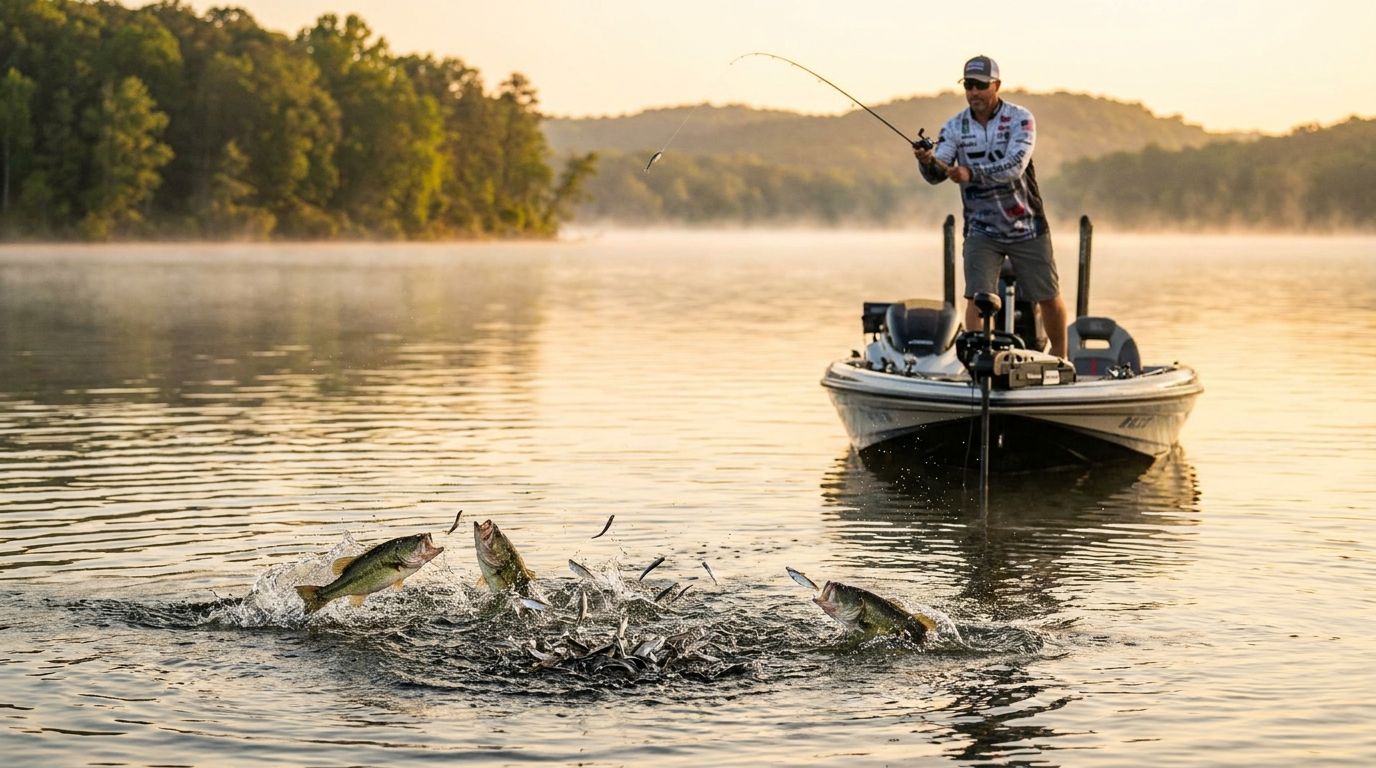
Shad Are the Map
In early summer on most reservoirs, if you find shad, you find bass. The relationship is that direct. Schools of gizzard shad and threadfin shad move through the water column in predictable patterns as water temperature climbs, and bass shadow them from below.
Understanding how shad behave — where they go at different times of day, how they react to temperature stratification, when they're most accessible — is the foundation of early-summer bass fishing.
The Shad Spawn: The Season's First Major Event
Before the summer shad pattern fully establishes, the shad spawn creates one of the most concentrated early-summer feeding opportunities. Threadfin and gizzard shad spawn in late spring and early summer along hard structure — rip-rap, bridge pilings, riprap dam faces — in very shallow water (1–3 feet) at dawn.
The shad spawn is often visible: shad thrashing at the surface, commotion along the bank at first light, white flashing in the water at the bank edge.
Bass station along this structure during the shad spawn and feed aggressively. The window is short — typically 6 AM to 8 AM, sometimes shorter. But the catching can be exceptional.
Best presentations during shad spawn:
- Topwater walkers and poppers worked parallel to rip-rap
- Small jerkbaits retrieved erratically through the commotion
- Shad-colored swim jigs worked along the bank face
For more on shad spawn topwater, see Morning Topwater Bite.
Mid-Day Shad Patterns (June–July)
After the shad spawn concludes and water temperatures stabilize in the 72°F–78°F range, shad establish their summer pattern: deep during the heat of the day, shallowing in low-light periods.
Following the Thermocline
Most stratified reservoirs develop a thermocline in summer — a layer of rapidly changing temperature between warm surface water and cooler deep water. Shad concentrate at and just above the thermocline because oxygen is highest there.
Typical summer thermocline depths: 18–28 feet on most southern reservoirs. The exact depth varies by lake clarity, size, and weather history.
Bass holding below shad schools at the thermocline are using the thermal boundary as a wall — baitfish above them, cold anoxic water below. They're in a feeding position by default.
Use your sonar temperature probe (if available) or study your side imaging for the diffuse "band" that appears at thermocline depth. The fuzzy return above hard bottom, suspended at a consistent depth, is often the shad school above the thermocline. Bass should be just below.
Baitfish on Offshore Points and Humps
Shad school over offshore structure in summer. Humps, main-lake points, and ledges concentrate shad and, by extension, bass. Electronics reveal this directly: shad clouds above the structure, bass marks below or mixed in.
Presentations for bass associated with shad schools:
- Drop shot with a small shad-profile bait at the exact depth of the school
- Jigging spoon dropped through the school — bass hit it as it falls through
- Swimbait at the schooling depth, retrieved through the school
- Topwater when shad push to the surface (look for bass blowups)
The Strike King Red Eye Shad (/products/red-eye-shad) is ideal for this pattern — yo-yo it vertically through shad schools or cast and retrieve at school depth.
The Evening Shad Push
At dusk, shad schools move shallow. Bass follow. This creates a second topwater window in the 7 PM–9 PM range that mirrors the morning bite but often runs longer as light fades more gradually.
The same structure that produced in the morning — rip-rap, grass edges, cove mouths — becomes active again. Topwater and swim jig work the shallowing bait.
This evening pattern is often better than the morning pattern in July and August because cumulative day heat has suppressed morning activity but the evening is cooler.
Matching Your Lure to Shad Size
Shad size varies dramatically by season and lake. Shad that spawned in March are already 2–3 inches by June. Last year's class might be 4–6 inches. This matters for lure selection.
Small shad (1.5–2.5 inches) → 2.5–3 inch swimbait, small lipless crankbait (Red Eye Shad)
Medium shad (2.5–4 inches) → 3.5–4 inch paddle tail, mid-depth crankbait
Large shad (4–6 inches) → larger swimbaits, 6th Sense Crush 500DD (/products/crush-500dd)
A bass feeding on 2-inch shad schoolers won't commit to a 5-inch swimbait. Scale your bait to the prey the fish are eating — visually check what shad are in the area by examining stomach contents of caught fish (or just look at what's jumping and fleeing).
Building the Early Summer Day Plan
A productive early-summer day plan built around shad:
| Time | Pattern | Location |
|------|---------|----------|
| Pre-dawn to 7 AM | Shad spawn, topwater | Rip-rap, bridge pilings |
| 7–9 AM | Transitional | Grass edges, cove mouths |
| 9 AM–noon | Offshore, mid-depth | Main-lake points, humps |
| Noon–5 PM | Deep, electronics | Ledges, thermocline structure |
| 5–8 PM | Shad push shallow | Same shallows as morning |
This plan covers the full day efficiently without chasing patterns that don't fit the time.
The Fall Reservoir Shad Kit and Offshore Deep Shad Kit cover the lure systems needed for the full range of summer shad patterns. For background on shad as a forage type, see the Shad Pattern Guide and What Bass Eat by Season.
Shad pattern in-depth analysis at Bassmaster and Wired2Fish.