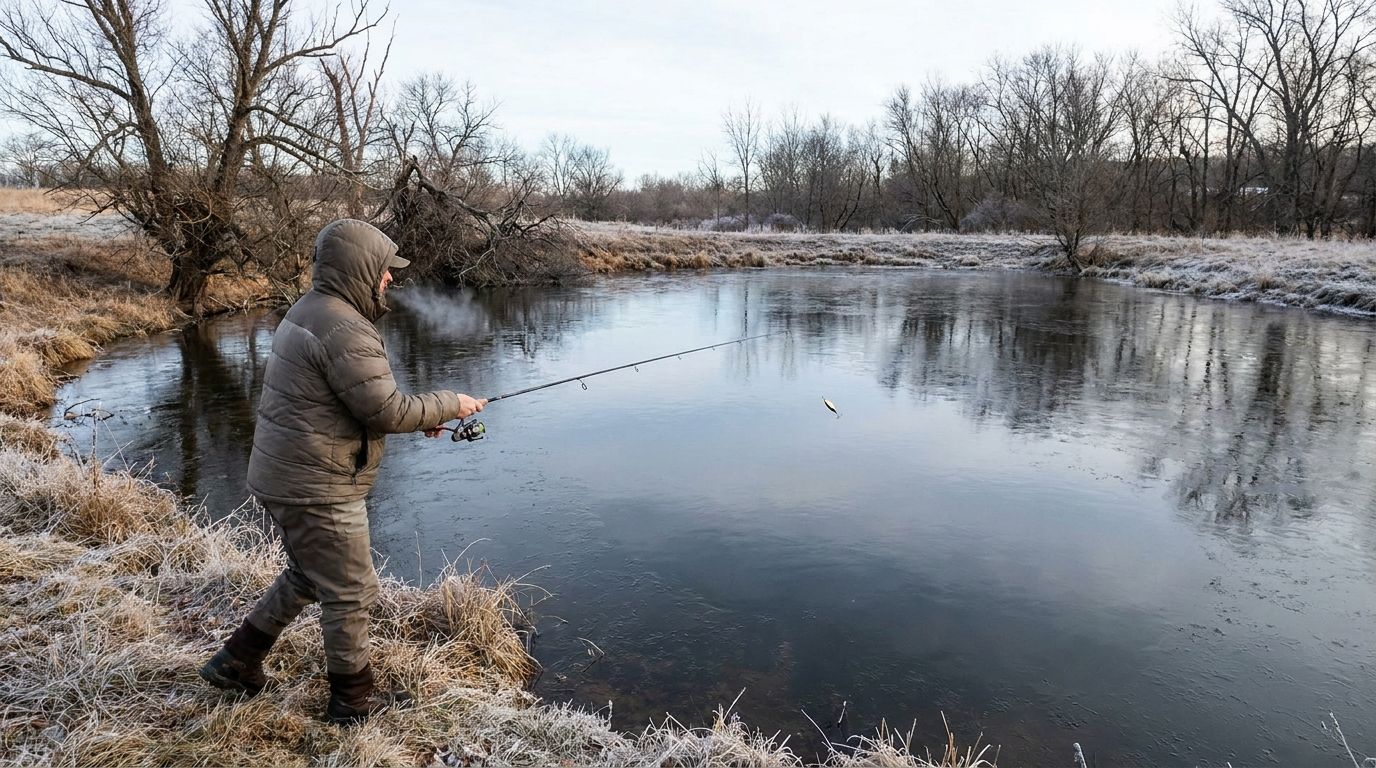
Why Ponds Are Worth Fishing in Winter
Most anglers pack it in at the reservoir when November hits. But small ponds — farm ponds, retention basins, private impoundments — can offer surprisingly good winter bass fishing for one simple reason: they're shallow.
Shallow water means fish can't go as deep as they do in reservoirs. A typical 3–8 acre farm pond might max out at 12–15 feet. Bass have a limited range to work with. Combined with the predictability of winter patterns, this concentration effect makes winter ponds more fishable than you might expect.
The tradeoff is that weather affects small water more severely than large reservoirs. A cold front that moves 5°F on a 500-acre lake might move the same pond 10°F. Timing your visits around stable weather matters more on ponds.
Where Pond Bass Go in Winter
With limited depth options, pond bass use three primary locations in winter:
The deepest hole. Every pond has a deep spot — the original creek channel, the spillway depression, or a dug-out area near the dam. Bass congregate here in the coldest weather. On a 10-acre pond, the deep hole might be 2–3 bass lengths across, with 8–12 fish stacked in it. When you find it, fish it slowly.
South-facing banks with dark bottom. The afternoon sun hits south-facing banks directly, warming the shallow water 2–4°F above the rest of the pond. On clear winter days, this warming effect can trigger brief feeding windows. In black-bottom ponds, the heat absorption is even more pronounced.
Inflows. If the pond has a stream inlet, spring, or pipe feeding it, that area will often hold the most active fish. Any inflow that brings slightly warmer water than the main pond is a magnet.
Reading the Weather Before a Winter Pond Trip
Don't drive to a pond the day after a cold front. Bass fishing in ponds after a front in January is typically futile — water temperature swings are too severe, and fish lock up hard.
Best conditions for winter pond fishing:
- Three or more days after the last cold front
- Stable or slowly rising air temperatures
- Afternoon timeframe on sunny days (wait for the sun to warm the shallow water)
- Overcast but mild — clouds keep temperatures stable
- Day of or day after a cold front
- Strong northwest wind (front indicator)
- Severe overnight temperature drops
Techniques for Winter Ponds
Ned Rig
A small mushroom jig (1/15 to 1/8 oz) with a 2.5-inch worm or craw is the single most effective winter pond technique. Fish it on light line (6–8 lb fluorocarbon) near the deep hole. Drag it agonizingly slowly. The floating tail does the work.
Small Jig
A compact 3/16 oz ball-head or arkie jig with a small craw trailer is effective around any structure near the deep hole — fallen branches, old dock pilings, rocky outcroppings. Fish it like a Ned rig — drag, pause, drag.
Drop Shot
In the deepest part of the pond, a drop shot lowered straight down and barely moved can pick off lethargic fish that won't track a horizontal presentation. Less common on ponds than reservoirs, but effective.
Suspending Jerkbait (Warmer Days)
When pond water is in the 48–56°F range — typically late January through February in the south — a small suspending jerkbait on main pond points or around dock areas can trigger fish. Use a shorter model (3.5–4 inch) sized appropriately for the water.
Winter Pond Gear
Light is the right choice for winter ponds:
- 6'10" to 7'2" medium-light spinning rod
- 2500 series spinning reel
- 6–8 lb fluorocarbon or 8 lb braid with 6 lb fluoro leader
- Small lure selection — don't overwhelm small-pond bass with big profiles
The Pond Bluegill Starter Kit includes smaller-profile baits appropriate for winter pond sizing. For year-round pond strategy beyond winter, Pond Fishing Year Round covers the full seasonal cycle.
Catch-and-Release Care in Cold Water
Bass physiology changes in cold water. They recover more slowly from the stress of being caught and held out of water. In winter:
- Minimize air exposure — 15 seconds maximum when possible
- Keep the fish in a net in the water if you're photographing
- Don't hold the fish vertically by the jaw — horizontal support protects the jaw joint
- Release into the same temperature water, not into warmer or colder pockets
Cold-water bass may look recovered when you release them but still be stressed. Extra care means those fish are there for next season.
Cold-water bass behavior and care details at In-Fisherman and Take Me Fishing.