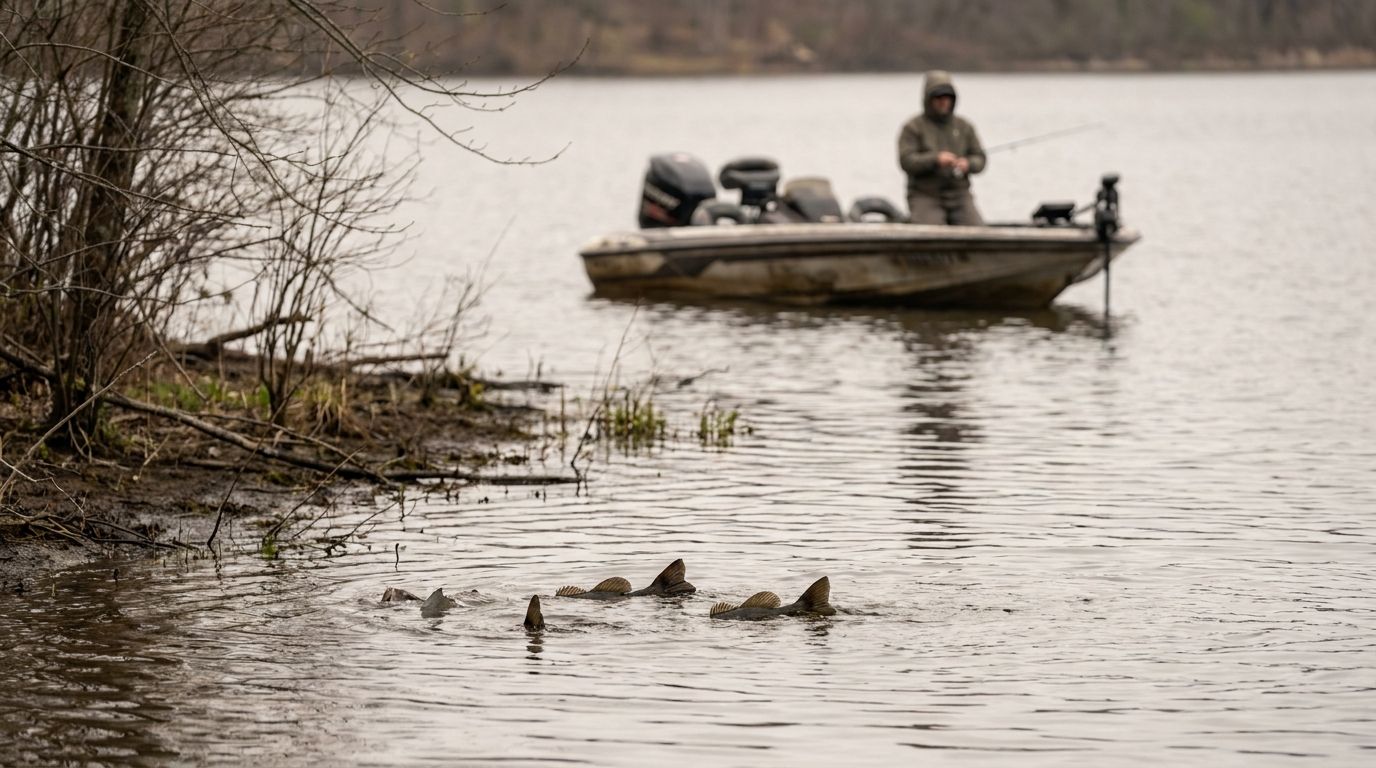
Why Mudflats Get Overlooked
The standard pre-spawn playbook focuses on rock, rip-rap, gravel, and chunk-rock banks — and for good reason. Crawfish concentrate on hard substrate, and pre-spawn bass follow crawfish. It's a legitimate, reliable pattern.
But it leaves fish on the table. Mudflats — soft-bottomed, shallow areas adjacent to spawning habitat — warm faster than rock in early spring, hold significant quantities of softer-bottom forage (worms, small crayfish, mud-dwelling invertebrates), and are often ignored by other anglers. On lakes where rock is abundant and competition is high, the mudflat bass are the most catchable fish of the pre-spawn.
Identifying Quality Mudflats
Not all mudflats are created equal. The ones that hold pre-spawn bass share these characteristics:
Adjacent to spawning habitat. The mudflat needs to be near the flat where bass will eventually spawn — within a short lateral move. Isolated mudflats in the middle of deep water don't function as staging areas.
South or west facing. Solar radiation hits south and west-facing banks in the afternoon. A south-facing mudflat in February can be 5–6°F warmer than the main lake by 3 PM. That thermal advantage is the single biggest attractor for pre-spawn fish.
Gradual depth transition. The best mudflats taper from 1–3 feet out to 6–10 feet over a long gradual slope rather than dropping abruptly. That gradual transition gives bass a comfortable feeding range without exposing themselves to deep water.
Presence of dark bottom. Dark, organic-rich mud absorbs solar heat faster than lighter clay or sand. On a sunny February day, dark mud flats are significantly warmer than lighter-bottomed areas of the same depth.
Some emergent vegetation or debris. Even sparse residual vegetation — dead grass stems, brush, fallen logs — on a mudflat gives bass a reason to stop and hold rather than just pass through.
Water Temperature on Mudflats vs. Rock
This is the central reason mudflats matter in early spring: they warm faster.
In early February on a 46°F lake, a south-facing mudflat with dark bottom may reach 50–52°F in direct afternoon sun. The rocky north-facing banks are still at 46°F. Bass don't stay at 46°F when 50°F water is accessible nearby.
Fish mudflats in the afternoon when warming is at its peak. Morning mudflats may be no warmer than the rest of the lake. The afternoon is when the temperature advantage shows up and fish activity peaks.
Techniques for Mudflat Bass
Soft plastic on a light Carolina rig. A 3/16 to 1/4 oz Carolina rig with a floating worm or creature bait dragged slowly across soft bottom is a highly effective mudflat technique. The rig doesn't snag (no hard obstacles on a soft flat), and the dragging weight leaves a mud trail that can attract bass. Long leader (24–30 inches) lets the bait float naturally above the mud.
Paddle-tail swimbait. A 3–3.5 inch paddle-tail on a 3/16 oz swimbait head swum just above the mudflat surface covers water efficiently. Retrieve slowly — barely above bottom, with occasional contact that stirs up mud. This imitates a small baitfish or worm working along bottom.
Topwater (on warm afternoons). When mudflat water reaches 54°F+, topwater can produce pre-spawn fish in the shallowest portions. A subtle walking bait or small popper early and late in the afternoon produces when nothing else seems logical for the season.
Jig with larger trailer. On mudflats, a jig with a bulkier trailer creates more displacement and is easier for bass to detect in low-visibility soft-bottom conditions. A 3/8 oz arkie with a 4-inch craw trailer, hopped slowly along bottom, is effective when bass are more aggressive.
Reading Wind and Mudflats
Wind blowing directly into a mudflat stirs up the bottom, reduces visibility, and often improves fishing. The turbulence activates invertebrates in the mud, stirs scent, and makes bass less wary. On a windy pre-spawn day, check the mudflats that are receiving direct wind before fishing the protected rocky banks.
This is counterintuitive to anglers who prefer calm conditions, but mudflat bass with wind in their face are often more aggressive and less selective than fish in calm, clear conditions.
Putting It Together
The mudflat pattern is most reliable:
- Water temperature 48°F–58°F
- Afternoon timeframe (1 PM–4 PM) on sunny days
- South or west-facing orientation
- Following 3+ days of stable or warming weather
For the timing picture of where mudflats fit in the pre-spawn progression, see The Pre-Spawn Timeline. The Prespawn Craw Kit covers the lures that work best on this pattern — soft plastics in natural crawfish and worm colors that look right over dark mud bottom.
Pre-spawn pattern depth coverage at Bassmaster and Wired2Fish.