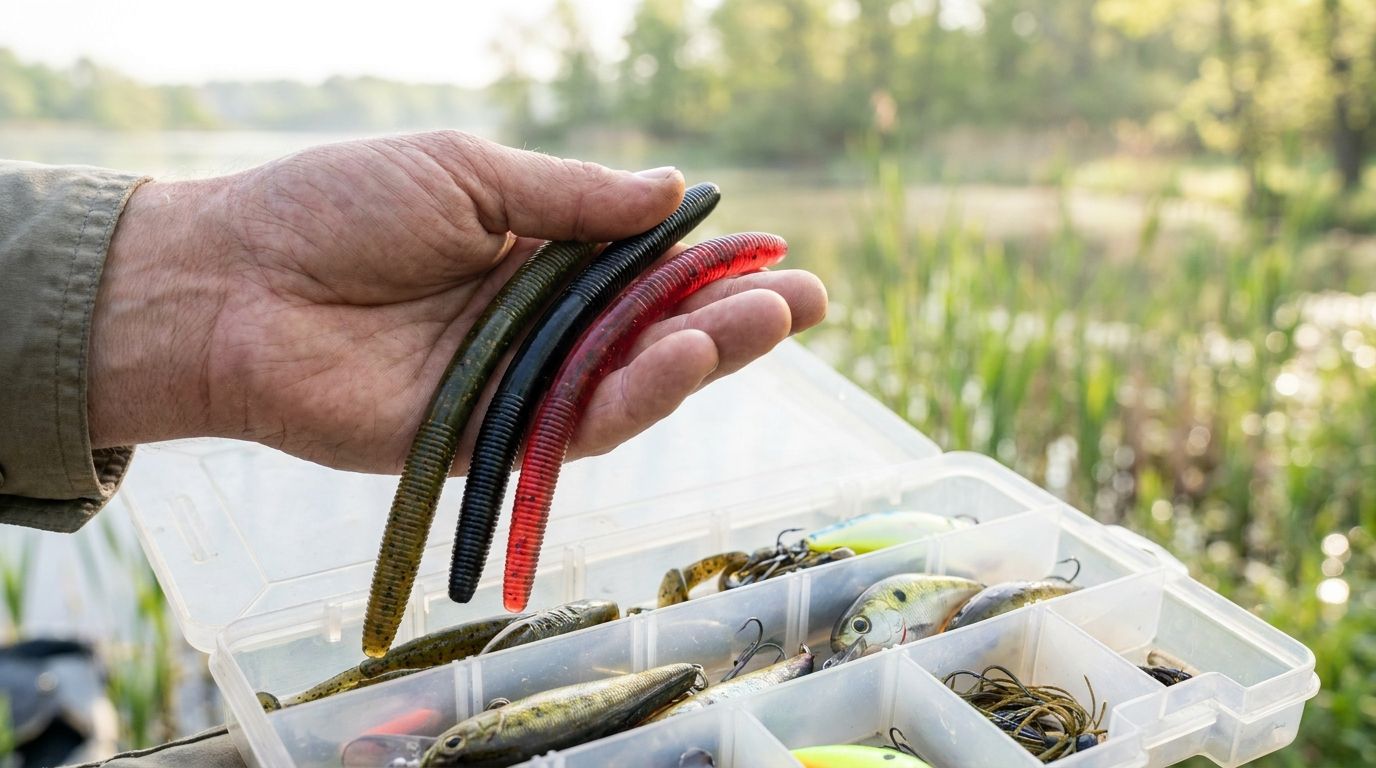
The Worm Is Never Wrong
Here's a truth that gets lost among flashier techniques: a properly rigged soft plastic worm works in every season, at every depth, and in nearly every water clarity. In spring, when bass behavior shifts rapidly across the pre-spawn, spawn, and post-spawn phases, the worm's versatility becomes especially valuable.
The worm doesn't have a specific season window like a buzzbait or spinnerbait. It fits everywhere.
Worm Styles for Spring
Not all soft plastic worms are the same. The profile and action determine when each works best.
Straight-tail worm (6–7 inch):
The most versatile. Minimal action on its own — relies on the rigging and retrieve. Texas-rigged, it falls horizontally and slowly, which is perfect for spawning-area presentations and pressured fish.
Curly-tail worm (6–7 inch):
The curled tail creates action even at very slow speeds. Good for Carolina rig applications where the bait needs to move but you're dragging slowly.
Ribbon-tail worm (7–10 inch):
The ribbon tail creates significant water displacement and a distinct throbbing action. Best in warmer water (60°F+) when bass are more active. Excellent for Texas rig around grass and wood in post-spawn.
Finesse worm (4–5 inch):
Small profile for pressured conditions, clear water, and shaky head presentations. The go-to in high-visibility water when larger baits get ignored.
Stick bait / stickworm (5–6 inch):
The Senko style. Weightless or lightly weighted, the stickworm falls horizontally with a subtle quiver — a legendary spawn and post-spawn bait.
Spring Rigging Options
Texas Rig
The workhorse. A bullet weight (3/16 to 3/8 oz) pegged or floating above the hook, weed-guard provided by the embedded hook point.
Best for: Cover — grass, laydowns, brush, dock pilings. Any place where an exposed hook would snag.
Spring application: Pitching and flipping to spawning-area cover (docks, laydowns adjacent to beds), working through shallow grass, deep ledge dragging in post-spawn.
Wacky Rig
The hook goes through the center of the worm (at the belly or through a rubber O-ring). On the fall, both ends quiver and flutter. Exceptional for sight-fishing to bedded bass.
Best for: Open water, clear water, sight-fishing situations, dock-shooting.
Spring application: Around dock edges during spawn, in clear-water coves sight-fishing, drop shots with wacky-style presentation.
Shaky Head
Covered fully at Shaky Head Finesse for Pre-Spawn Bass. The standard finesse approach for spring pressure.
Weightless / Stickworm
A plain stickworm with a single EWG hook, no weight. Falls horizontally on extremely slow sink rate.
Best for: Calm conditions, clear water, sight-fishing. Cast it out, watch it fall, watch the bass inhale it.
Spring application: One of the best spawn-phase baits in existence. Drop it near a bed and let it sink slowly. Works when almost nothing else will on cautious, pressured spawning fish.
Carolina Rig
Weight and swivel up the line, long leader to the hook. Drags along bottom while the bait floats naturally above.
Best for: Open bottom, long points, pre-spawn ledge and flat dragging.
Spring application: Pre-spawn staging areas and post-spawn transition zones.
Color Selection Through Spring
| Phase | Clarity | Colors |
|-------|---------|--------|
| Pre-spawn | Clear | Green pumpkin, watermelon seed |
| Pre-spawn | Stained | Dark blue/purple, black/blue |
| Spawn | Clear | Natural green pumpkin, watermelon red |
| Spawn | Stained | Junebug, dark watermelon |
| Post-spawn | Any | Match local baitfish — shad white, natural |
The general rule: natural in clear, dark and contrasting in stained. Red or orange tails add visibility and can trigger strikes when fish are sluggish.
Pre-Spawn Worm Fishing
In the staging zone (8–18 feet), a straight-tail worm Texas-rigged on a 3/8 oz bullet weight, dragged slowly along hard bottom, is a classic and effective approach. The worm's slow fall and subtle action doesn't threaten bass as aggressively as a jig but still triggers strikes from fish that are feeding.
Particularly effective on secondary points inside coves in 10–15 feet, where bass are staging before moving to spawning flats.
Spawn Phase Worm Fishing
Two worm approaches dominate during the spawn:
Stickworm (weightless or lightly weighted): Drop near beds, watch the fall, set the hook at any movement toward the fish or any line jump.
Creature bait or straight worm on bed: Place directly on the bed, leave it stationary. The bass perceives it as a threat to eggs and will remove it. The technique is the same as described in Bed Fishing for Bass.
Post-Spawn Worm Fishing
After the spawn, female bass suspend and recover while males guard fry. The feeding pattern is irregular and fish are scattered. A ribbon-tail worm Texas-rigged through grass and wood edges, or a soft-plastic worm on a shaky head on mid-depth structure, picks off recovering fish that are beginning to eat again.
For the full post-spawn transition, see Post-Spawn Bass Recovery.
The Jig + Craw Trailer Kit covers complementary bottom-contact presentations that work alongside worms through this entire spring window. Browse the full soft plastic lineup at the Shop.
More on spring soft plastics at Wired2Fish and Bassmaster.