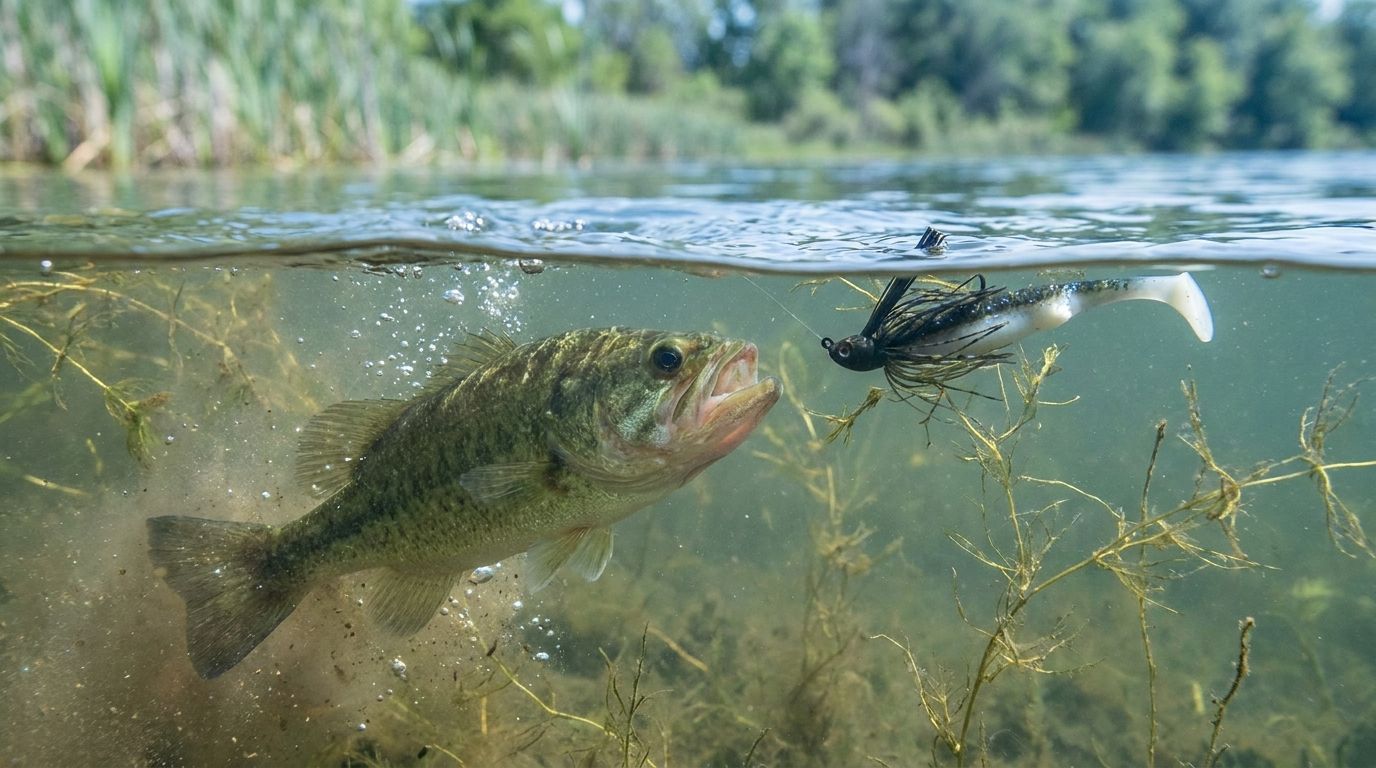
Why the Swim Jig Fits Post-Spawn Perfectly
Post-spawn bass are scattered. They're coming off the beds and fanning out across the water column, relating to cover adjacent to the spawning areas, and gradually transitioning toward early-summer feeding positions. Finding them requires covering water.
A swim jig fished at a slow-to-moderate speed in 2–6 feet of water covers ground efficiently, looks like a fleeing or swimming baitfish, and can be deflected off cover to trigger reactive strikes. It's one of the few lures that works well in both emergent vegetation and around dock edges without constant snag problems.
The 6th Sense Divine Swim Jig (/products/divine-swim-jig) is built specifically for this technique — a streamlined head that parts grass and deflects off wood, with a skirt profile that creates a consistent swimming action.
Setting Up the Swim Jig
Jig weight:
- 3/16 to 1/4 oz: Extremely shallow, 1–4 feet. Slow retrieve required to keep bait at this depth.
- 3/8 oz: Standard post-spawn depth (3–6 feet). The most versatile weight for this phase.
- 1/2 oz: When you need to get the jig down to 6–10 feet for fish that have moved slightly deeper post-spawn.
Trailer:
Trailer selection directly affects how the jig swims and what it matches.
- Boot-tail/paddle-tail swimbait: Creates a distinct tail kick with every retrieve movement. Matches shad pattern. Most productive when shad are the primary post-spawn forage. Try the Berkley PowerBait Swim Shad HD Bluegill (/products/berkley-swim-shad-bluegill) for a realistic profile.
- Grub with curled tail: Softer, more subtle action. Works when fish are less aggressive.
- Creature bait (trimmed): Adds appendage action without significantly increasing hook gap interference. Good when fish want something different from a standard swimbait profile.
- Straight chunk: No action. The jig head and skirt do the work. Effective in cold or post-front conditions when bass want minimal movement.
Color Selection
Match the forage — post-spawn bass are eating both baitfish and crawfish depending on where they are in the transition:
| Forage | Color |
|--------|-------|
| Shad (open water, dock edges) | White/chartreuse, pearl, shad gray |
| Bluegill/sunfish | Green pumpkin/orange, natural bream |
| Crawfish (rocky areas) | Green pumpkin/brown, brown/orange |
| Mixed or stained water | Chartreuse/white, black/blue |
The bluegill pattern is particularly productive in late spring and early summer — bass coming off the spawn are keyed on small sunfish that are also spawning in the shallows. A green pumpkin or natural bream swim jig in 1–4 feet near shallow rocky or gravel banks can be very effective.
For more on when to choose sunfish vs. shad patterns, see Bluegill vs Shad: When to Choose.
The Retrieve
Standard slow roll: The most common and most effective post-spawn retrieve. Reel steadily at a pace that keeps the jig barely below the surface, with the skirt flaring and the trailer tail kicking. The bait should look like a swimming baitfish moving with purpose.
Retrieve so slowly that it feels unproductive. If you can't feel the jig vibrating, you're going too slow — speed up just enough to feel the action. That's the right pace.
Burning: When bass are actively feeding and chasing, a fast retrieve near the surface triggers aggressive strikes. Less common post-spawn than mid-summer, but worth trying when conditions are active.
Pulsing: Instead of a steady retrieve, add rod tip drops and lifts — a slow, swimming jig that rises and falls. Effective around cover edges where a constant-depth retrieve might miss fish sitting at different heights.
Contact with cover: Every time the swim jig bumps a dock piling, deflects off a laydown, or pushes through a grass stem, it changes direction slightly. These deflections trigger strikes. Don't avoid contact — seek it.
Key Post-Spawn Locations
Dock lines: Bass recovering from the spawn hold on dock structure in the shallows. Work a swim jig parallel to a dock row, keeping it at 3–5 feet deep, passing close to each piling. Bites often come as the jig passes directly in front of a piling.
Shoreline laydowns and brush: A swim jig retrieved through a laydown tree — allowing it to deflect off branches — is an excellent post-spawn approach. The wood provides reference for recovering fish, and the deflection action triggers strikes.
Grass edges and pockets: The leading edge of any spring vegetation growth, from 2–5 feet deep, concentrates post-spawn bass transitioning toward summer grass patterns. The swim jig is weedless enough to work these edges cleanly.
Creek mouths: As fish move from spawning coves back toward main-lake staging areas, creek mouths are transition points. A swim jig worked along the channel edge at a creek mouth catches fish in both directions of movement.
When to Switch from Swim Jig
The swim jig loses effectiveness when:
- Bass aren't in the 2–6 foot range (move to deeper presentations)
- Fish are extremely lethargic post-front (finesse down)
- Heavy matted vegetation requires a different weedless option (frog or punch rig)
Pair the swim jig with a finesse backup — a drop shot or shaky head — to convert fish that follow the jig but won't eat.
The Bluegill Cover Kit and Summer Mats Frog Kit cover the complementary techniques for post-spawn shallow water. See Post-Spawn Bass Recovery for the full location picture.
More swim jig technique at Bassmaster.