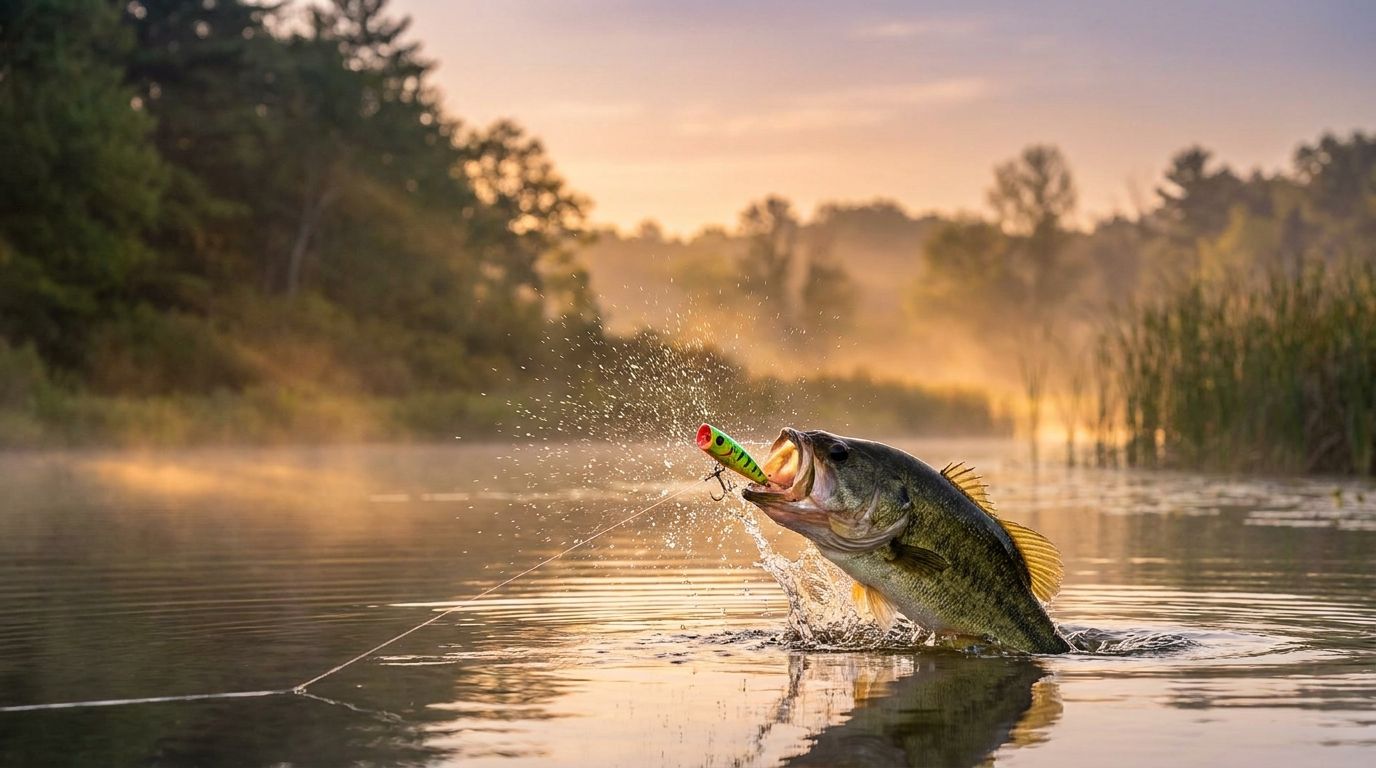
The Popper Gets No Respect
Ask a group of bass anglers what topwater baits they throw and you'll hear: Spook, Whopper Plopper, frog, buzzbait. The popper might get mentioned as an afterthought.
That's a mistake. The popper fills a specific niche that no other topwater bait occupies — it's designed for slower, more precise presentations in tighter areas, and it creates a distinct splash-and-spit action that triggers bass that have already seen walkers and frogs.
On pressured public lakes, on calm mornings in pockets and dock gaps, and on post-cold-front days when topwater is marginal, the popper often outperforms everything else.
What a Popper Does
A popper has a concave, scooped face that, when the angler pops the rod tip, pushes water forward and creates a splash combined with a distinctive "spitting" sound as air pockets form and collapse.
Unlike a walking bait that moves side-to-side, the popper stays in place — the action happens on the spot, then it sits still. This is the key behavioral difference: the popper works in a more stationary way, perfect for specific casting targets where you want the bait to stay put and work the spot.
A walking bait covers linear water. A popper covers a point.
When the Popper Outperforms
Calm, clear mornings: Calm water amplifies the popper's sound and visual impact. The splash and spit are obvious to bass from long distances. In slight chop, a buzzbait's noise advantage may surpass the popper — but in glassy conditions, the popper is unmatched.
Around dock edges and pilings: The popper's stationary action is ideal for casting to a specific piling, popping it in place, letting it sit, then popping again. A walking bait moves away from the target; a popper stays on it.
In pockets and openings in grass: Casting into a 3-foot opening in lily pads or hydrilla and working a popper in that small zone is extremely effective. The bait doesn't need to travel — it works the pocket.
Pressured fish: Bass that have been chased with walking baits all week may still eat a popper because it looks and sounds different. The splash and spit is a distinct trigger that walking-bait-weary fish haven't learned to avoid.
When fish are striking short on walkers: If bass are boiling on walkers but missing or short-striking, switch to a popper. The more stationary action gives them more time to acquire the target.
Stained water: The sound of a popper carries in stained water where bass might not visually locate a more subtle lure. The splash gives them an auditory reference.
The Retrieve
Popper fishing is about rhythm and patience.
The Standard Pop
Most anglers pop too frequently and don't wait long enough between pops. The fish often commit to the bait during the pause, not during the pop itself. A common effective cadence is pop—3-second wait—pop—5-second wait—pop.
The Walk-Pop Hybrid
Some poppers can be worked with a slight walking action combined with pops. This is faster and covers more water. Effective when fish are aggressive and you're searching rather than targeting a specific spot.
The Dead Pop
Pop once, hard. Then completely stop. Don't move the bait at all for 10, 15, even 20 seconds. The fish you saw following, or the one you didn't see, will often commit to the dead-still bait. This is the popper's version of the jerkbait long pause — and it's equally deadly.
Choosing Popper Size
| Target Fish / Situation | Popper Size |
|------------------------|-------------|
| Heavily pressured lakes | 50–60mm (small) |
| Standard spring/summer | 65–75mm |
| Trophy hunting, large lakes | 80–90mm |
| Clear, small ponds | 50–65mm |
The River2Sea Whopper Plopper 90 (/products/whopper-plopper-90-bluegill) occupies a different niche (it's a prop bait, not a traditional popper) but covers some of the same water with its rotating tail. When a traditional cup-face popper's splash isn't what fish want, the Whopper Plopper's prop-churn is an excellent alternative.
Popper Colors
| Conditions | Colors |
|-----------|--------|
| Clear water, sunny | Natural shad, white, bone |
| Stained, overcast | Chartreuse/white, yellow perch |
| Low light, very early | All black (silhouette pattern) |
| Bluegill spawn | Bluegill / orange belly |
| Shad spawn | Silver/chrome, pearl |
Color on a popper matters less than action, but matching the forage that fish are keyed on — bluegill in late spring, shad in summer — helps when fish are being selective.
Popper Gear
Rod: 7'0" medium action spinning or baitcasting rod. Medium action is ideal — a fast-tip rod makes it hard to load the pop properly; a stiff rod kills the bait's action.
Line: 12–15 lb monofilament or 20 lb braid with a 12 lb fluorocarbon leader (2 feet). Mono has enough shock absorption to keep hooks in fish on surface strikes. Braid with a fluoro leader works when distance is needed.
Hooks: Check the hooks on any popper out of the box. Many are undersized or use cheap hooks. Upgrading to premium trebles (Owner, VMC, Gamakatsu) is a worthwhile improvement.
Pairing the Popper with Other Topwater
The popper doesn't replace the walking bait or frog — it completes the topwater system. Fish a walking bait first to cover water and locate active fish. When you find a specific high-quality spot (dock pocket, grass opening, isolated laydown), switch to the popper to work it methodically.
For the full topwater picture across the season, see Late Spring Topwater Fishing and Morning Topwater Bite. The Bluegill Topwater Kit and Shallow Ambush Topwater Kit include options that pair with popper fishing for complete topwater coverage.
For matching topwater to seasonal forage, check What Bass Eat by Season and use the Fish Finder to confirm the right pattern.
More popper technique and topwater bass fishing at Wired2Fish and Bassmaster.