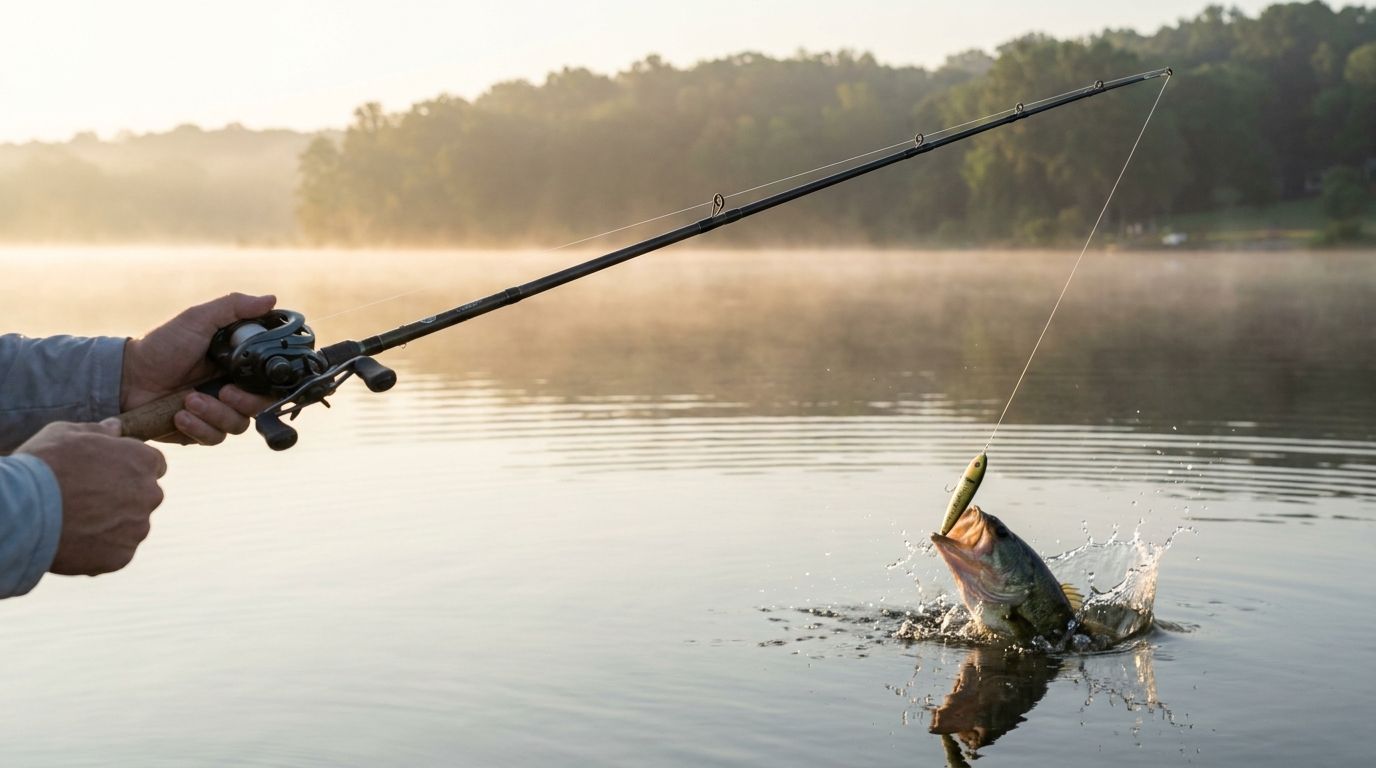
What Makes a Walker Walk
Walking topwater baits — Spooks, Gunfish, Skitters, One Knockers — are designed to move side to side in a rhythmic zigzag pattern as you retrieve. This action mimics a wounded or disoriented baitfish struggling at the surface.
The action is created by the angler, not the lure. The lure is intentionally designed without inherent action — it needs the angler's rod work to produce the walk-the-dog retrieve. This is why so many anglers fish walking baits less effectively than they could: they expect the lure to do the work.
Learning the retrieve is 80% of walking bait success.
The Walk-the-Dog Retrieve
The Basic Mechanics
The key is the combination of the rod pop and reeling slack simultaneously. If you don't reel in the slack after each pop, the bait won't swing correctly — it will surge forward instead of walking side to side.
Rhythm and Cadence
The walk-the-dog retrieve is rhythmic. Pop, reel, pop, reel — a metronome tempo. The bait should swing left, right, left, right in consistent arcs. When you get it right, the bait seems to swim on its own.
Different anglers develop slightly different cadences. Some prefer fast pops with quick swings. Others prefer slower, wider swings with more pause. Generally:
- Fast cadence: More aggressive action, less time in any one spot. Better for covering water and when fish are actively feeding.
- Slow cadence with pauses: More time in the strike zone, more subtle action. Better for pressured fish or low-activity windows.
The Pause
After a series of walks, stopping completely is a powerful trigger. The bait sits motionless — a dead baitfish. Many of the largest strikes on walking baits come after a pause, not during the walk.
Try a walk-pause-walk pattern: 4–5 walks, full stop for 2–3 seconds, then resume. This works particularly well when bass are following but not committing.
Bait Selection
Whopper Plopper vs. Traditional Walker
The River2Sea Whopper Plopper 90 Bluegill (/products/whopper-plopper-90-bluegill) is technically a walker with a prop tail — it combines the walking motion with a churning tail noise. Unlike traditional walkers, the Whopper Plopper doesn't require the same precise cadence to work. A steady retrieve activates the tail; a stop creates the walking motion as it drifts. More accessible for beginners.
Traditional walkers (Spook, Gunfish, etc.) require the learned cadence but reward it with precise action control and versatility. In windy conditions, calmer conditions, clear water — the angler can adjust the presentation precisely.
Size Matching
- 75–90mm: Match smaller shad and bluegill. Works well on pressured water and when fish are keyed on smaller prey. The 90mm Whopper Plopper is ideal for this range.
- 100–110mm: Standard all-around walking bait size. Covers most spring and summer situations.
- 120mm+: When big bass are the target and you want to select for quality over numbers. Less productive on average but attracts larger fish.
Gear Setup
Rod: 7'0"–7'4" medium baitcaster with a moderate to moderate-fast action. A stiff rod kills the action; the tip needs to load slightly on each pop to give the bait the right movement. Medium action is correct for most walking baits.
Reel: Baitcaster, 7.1:1 ratio. The reel speed matters — too slow and you can't take in slack fast enough to maintain the cadence.
Line: 15–20 lb monofilament for the stretch and shock absorption. When a bass explodes on a topwater bait and shakes its head, the stretch of monofilament keeps hooks pinned. Braid with zero stretch results in more pulled hooks on aggressive surface strikes.
Knot: An open loop knot (non-slip loop) allows the lure to swing freely side to side on the line, enhancing the walking action. A clinch knot restricts movement slightly.
Where and When to Walk the Dog
Best times:
- Dawn to 8 AM — prime window for most topwater
- Dusk — evening bite on the same shallow areas
- Overcast conditions — extended feeding windows under cloud cover
- Night (summer) — large walking baits with rattles in very shallow water
- Grass edges and pockets — walk the bait through openings in vegetation
- Rip-rap — along the face at dawn during shad spawn
- Dock lines — parallel to the dock edge
- Open, shallow flats over submerged grass — summer morning pattern
- Spawning areas during shad or bluegill spawn
For the broader topwater window timing, see Late Spring Topwater Fishing and Morning Topwater Bite.
Hookup Ratio Improvement
Walking baits have notorious missed-strike problems. The fish explodes and misses, or you set too early and pull the bait away.
Rules:
- Don't set the hook on the boil. Set the hook when you feel weight.
- If you can't stop yourself from setting early, point the rod at the fish on the cast, so your hookset has no lever — you physically can't set hard enough to pull the bait away.
- Use feathered treble hooks on the rear hook — they increase hookup ratio on short strikes
The Shallow Ambush Topwater Kit and Bluegill Topwater Kit include walking baits and the hooks and accessories to maximize hookup ratios.
More walking bait technique from Wired2Fish — some of the best video tutorials on walk-the-dog retrieve in the industry.