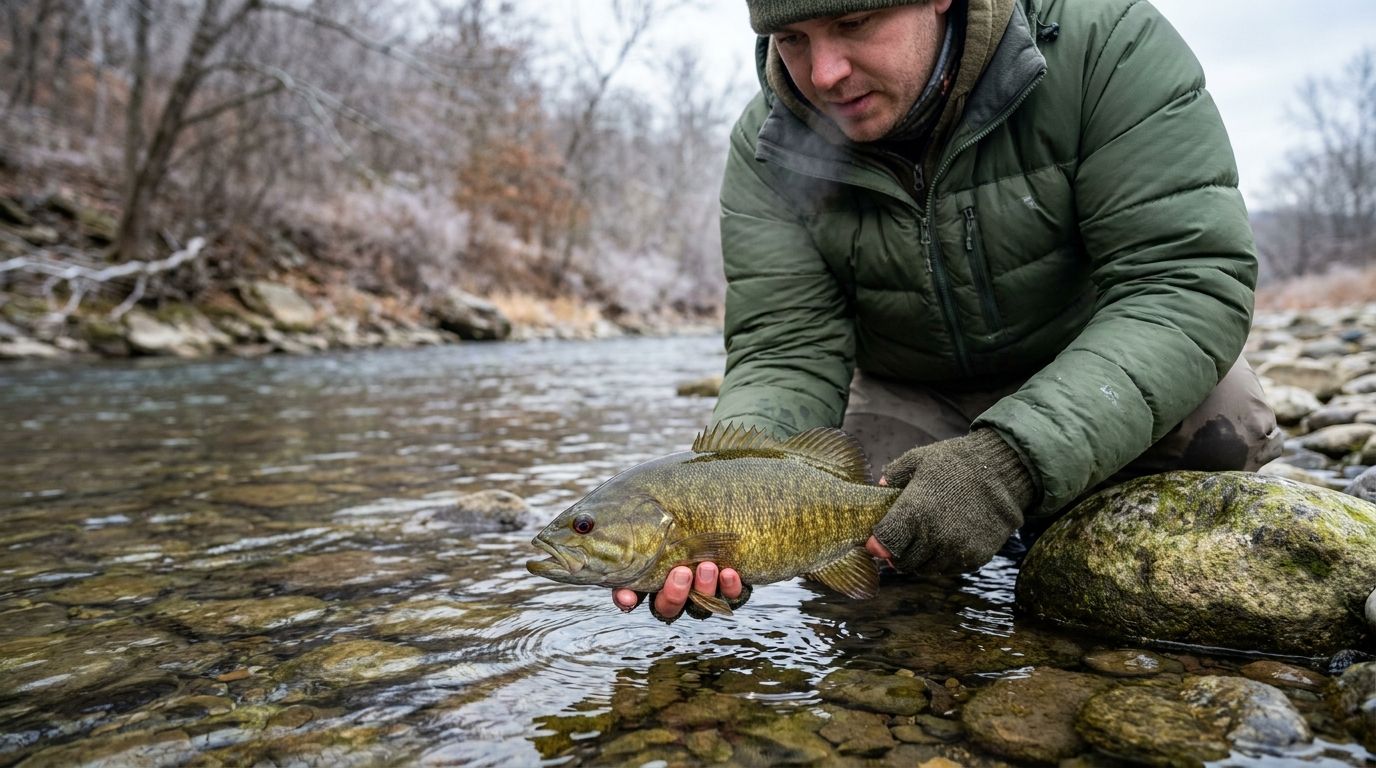
Smallmouth vs. Largemouth in Winter
The first thing to understand about winter smallmouth: they're not largemouth.
Smallmouth bass have a higher metabolic rate and tolerate colder water temperatures better than largemouth. While largemouth become nearly lethargic at 40°F, smallmouth in the same water are still feeding — actively, in some cases. Their preferred thermal range extends 5–8 degrees colder than largemouth, which means winter smallmouth fishing is real fishing, not a survival exercise.
The tradeoff is specificity. Smallmouth in winter are in specific spots, eating specific things, in ways that demand precision. Blunder in with the wrong approach and you get skunked on a lake full of feeding fish.
Where Winter Smallmouth Live
Rivers and tailwaters: Current-driven smallmouth systems don't stratify like reservoirs. Smallmouth hold in current seams, behind boulders, and in deep eddy pools adjacent to fast water. Tailwaters below dams often warm from discharge and hold fish concentrations through the coldest months.
Reservoirs: On impoundments, smallmouth follow the same general pattern as largemouth — main-lake structure at depth — but they tend to go deeper and relate tighter to rock. A main-lake point with chunk rock or gravel bottom in 25–40 feet is classic winter smallmouth habitat on TVA and highland reservoirs.
Natural lakes: Northern natural lakes hold smallmouth on deep rock piles, gravel bars, and the rock transitions between shallow and deep. Depths of 20–40 feet are typical. Ice fishing anglers know these spots well — they're the same spots that produce in open water.
The Core Winter Smallmouth Presentation
Drop Shot
The drop shot is the most consistently productive winter smallmouth technique. Position over deep fish, drop to depth, and shake with minimal movement.
Smallmouth-specific adjustments:
- Use a longer leader — 14 to 20 inches instead of 10–12 — because smallmouth tend to suspend higher off bottom than largemouth
- Smaller baits: 3–3.5 inch finesse worm or small swimbait on a size 1 hook
- Lighter line: 8 lb braid to a 6 lb fluorocarbon leader for maximum sensitivity and minimum visibility in clear northern water
Blade Bait / Jigging Spoon
For vertical jigging on sonar-marked fish, nothing beats a blade bait or jigging spoon. Smallmouth will chase these more aggressively than largemouth in cold water. The lift-and-flutter action on a compact blade bait triggers reactive strikes from fish that aren't aggressively feeding.
Key: match the size to depth. A 1/2 oz blade covers 15–30 feet. Go up to 3/4 oz in deeper water or current.
Tube Bait
The tube is the classic cold-water smallmouth bait on natural lakes. A 3–4 inch tube on a 3/8 oz internal jig head, dragged slowly along rock bottom, mimics a dying goby or crawfish with uncanny accuracy. The spiraling fall on slack line is a trigger that smallmouth find irresistible.
Rig it on a 7 lb fluorocarbon leader and cast onto the lip of a rock pile, letting it tumble down the slope. Most strikes come on the initial fall or the first drag.
Suspending Jerkbait
When smallmouth are in the 12–22 foot range and showing willingness to chase, a suspending jerkbait works well. The presentation is the same as for largemouth — hard twitches followed by long pauses — but smallmouth tend to respond to slightly shorter pauses and a bit more erratic action than winter largemouth.
See Winter Jerkbait Fishing for detailed jerkbait technique.
Color Patterns
| Condition | Top Colors |
|-----------|-----------|
| Clear water | Natural goby (brown/green), smoke, clear |
| Stained water | Watermelon red, green pumpkin |
| Low light | Brown/purple, dark green |
| Sunny, high pressure | Natural craw, light green pumpkin |
In clear smallmouth systems, natural color matching is more important than in largemouth fisheries. Smallmouth in 30 feet of clear water get a long look at your bait.
Fishing Rivers in Winter
River smallmouth are a different challenge. You're fighting current, reading hydraulics, and presenting to fish that hold in specific slack-water pockets.
Key spots:
- Immediately behind large boulders — the slack zone directly downstream
- Deep pool tail-outs where current slackens before the next riffle
- Inside bends where sediment deposits create a softer, slower bottom
- Eddies below current breaks — the reverse-current pocket holds smallmouth like a magnet
Presentation in current: cast upstream of the target, let the bait swing naturally through the slack zone. Control the speed with rod position, not retrieve speed. In cold water, almost no retrieve is usually the right amount of retrieve.
When Smallmouth Are Truly Off
Below 38°F in still water, even smallmouth get slow. That's the threshold for pure finesse work. Drop shot with the smallest possible worm, barely moving, directly on top of marked fish.
If you're fishing a natural lake in the north and seeing marks at 35–40 feet in January, that's the game. It's patience work, not power fishing. But those fish are there, and they will bite.
For pairing these techniques with the right lure systems, the Cold-Front Jerkbait Shad Kit has the jerkbait components, and January Bass Patterns continues the cold-water location story into the new year.
Smallmouth-specific winter tactics at In-Fisherman — they cover cold-water smallmouth better than nearly any other publication.