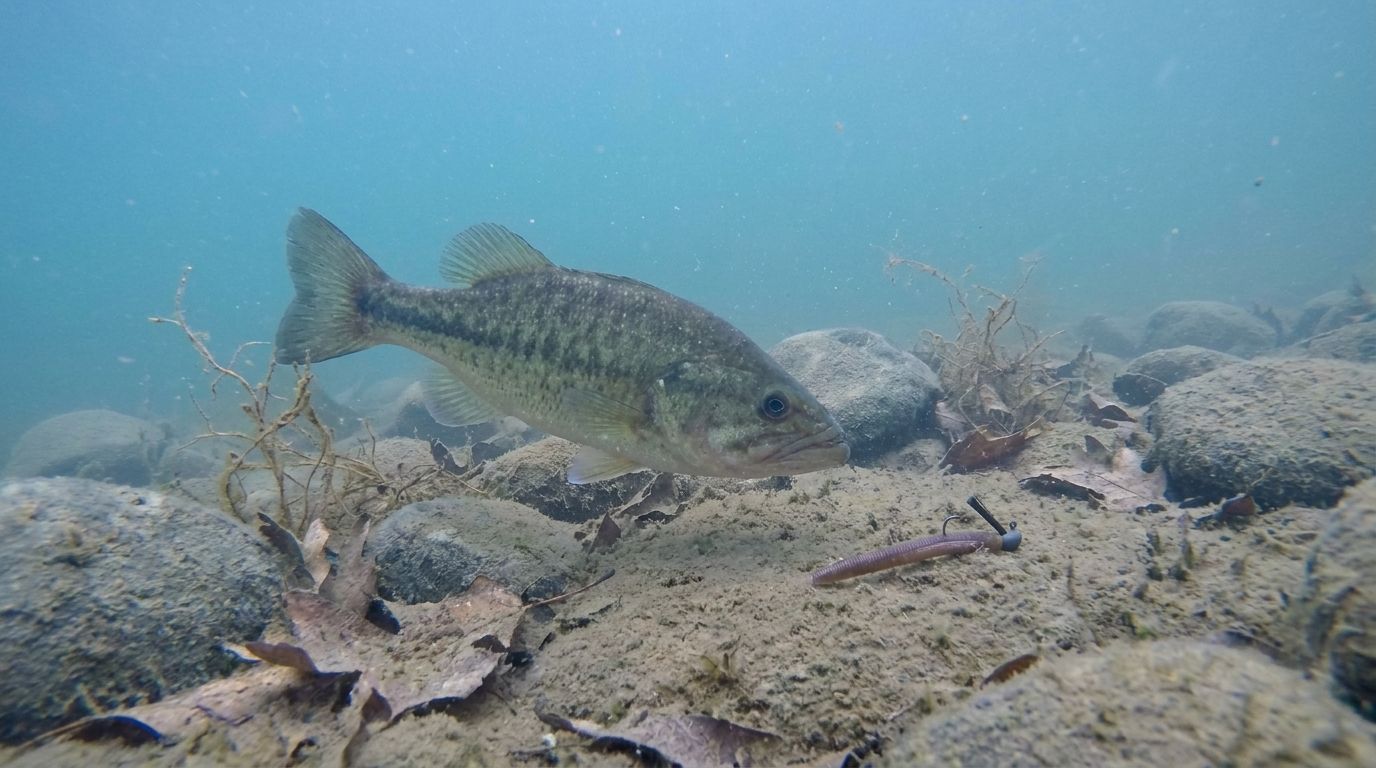
Bass Are Ectotherms
Bass are cold-blooded — their body temperature matches the surrounding water. Unlike mammals that maintain internal warmth regardless of ambient temperature, a bass in 40°F water has a body temperature of 40°F. Its enzyme systems, muscle fiber activation, and neural processing all slow proportionally.
This isn't a minor effect. The metabolic rate of a bass roughly doubles for every 18°F increase in water temperature. That means a bass at 40°F is operating at roughly one-quarter the metabolic rate of the same fish at 76°F. It needs less food, reacts more slowly, and burns fewer calories doing anything — including catching prey.
Understanding this changes how you approach cold-water fishing at a fundamental level.
What Happens at Specific Temperatures
Above 60°F: Bass are metabolically active. They feed regularly, chase baits readily, and recover quickly from being caught. Most power fishing techniques work.
50°F–60°F: Metabolism is moderately reduced. Bass still feed, but less often and with less intensity. Reaction times slow. Faster presentations need to slow down.
40°F–50°F: Significant metabolic slowdown. Bass feed opportunistically, not regularly. They won't chase. They'll eat what comes to them. Presentations must be slow, close to the fish, and in the strike zone long enough for a slow-moving fish to commit.
Below 40°F: Bass are in near-dormancy. They'll eat in some circumstances — warm afternoons, ideal pressure, the right presentation — but it's exceptional. Best strategy is to focus on depths with the most stable temperatures and fish the most compact, subtle presentations available.
How This Changes Your Presentation
Slow Is Relative
"Slowing down" means different things at different temperatures. At 55°F, slowing down means 3-second pauses instead of 1-second pauses. At 42°F, slowing down means 20-second pauses and a retrieve speed that barely moves the bait across the bottom.
A useful mental model: imagine the bass moving in slow motion. Your bait needs to enter its vision, be close enough to eat without significant movement, and stay there long enough for the fish to decide to eat. Everything follows from that.
Presentation Distance
In warm water, a bass will track a bait 15 feet and accelerate to catch it. In cold water, that tracking distance shrinks dramatically. If your bait passes 4 feet in front of a bass at 42°F and moves on, the bass probably didn't eat it — not because it wasn't interested, but because it couldn't or wouldn't make the effort.
This is why vertical presentations (blade bait, jigging spoon, drop shot straight down over marked fish) are so effective in winter. You're putting the bait directly on the fish, not asking them to pursue.
Hookset Adjustment
Cold-water bass bite with less force and may barely close their mouths around a lure. The subtle "weight" feeling on a winter bite is partly because the fish isn't slamming the bait — it's slowly engulfing it.
This means:
- Keep the line tight enough to detect light bites
- Set the hook at the first hint of anything different
- Don't wait for the classic hard thump — you may wait forever
Digestion and Feeding Frequency
A bass at 50°F digests its last meal about twice as slowly as the same fish at 68°F. This is why winter bass don't feed daily. A large meal may satisfy a cold-water bass for 48–72 hours before it's ready to feed again.
This explains the unpredictability of winter fishing. You might find active fish one day and the same spot completely cold the next — because those fish ate yesterday and aren't hungry today. When you do find feeding fish in winter, it's often worth working the area thoroughly before moving.
Practical Implications for Lure Choice
The metabolic science points directly to technique selection:
- Drop shot, Ned rig: Stay stationary in front of the fish — ideal for slow-metabolism fish that won't chase
- Suspending jerkbait: Hangs motionless on long pauses — long enough for a slow fish to commit
- Blade bait/jigging spoon: Comes directly to the fish vertically — minimal pursuit required
- Fast-moving crankbaits in winter: Generally ineffective because they move through the strike zone too quickly
The exception is when a cold-water bass triggers reactively. Even at low metabolism, a reflex strike can occur when a bait moves erratically right in front of a fish. This is why blade baits with their sudden flutter can trigger fish that won't respond to slower baits — the sudden movement triggers an involuntary response before the fish "decides" not to strike.
Temperature and Timing
Bass in cold water are most likely to feed during the warmest part of the day — typically 11 AM to 3 PM in winter. The 2–4 degree temperature rise during afternoon hours can shift bass from passive to mildly active.
South-facing banks, dark-bottom areas, and shallow coves that heat fastest are the places to be during the afternoon window. At first light in January, even those spots may be too cold for active fish.
This is the opposite of summer, when dawn and dusk are peak times. Adjust your schedule.
For technique-specific cold-water guidance, see Cold-Water Finesse Fishing and Drop Shot in Cold Water. The Seasonal Fishing Calendar shows how seasonal timing lines up with these temperature thresholds by region.
Bass biology explained in detail at In-Fisherman — their cold-water biology archives are worth reading.