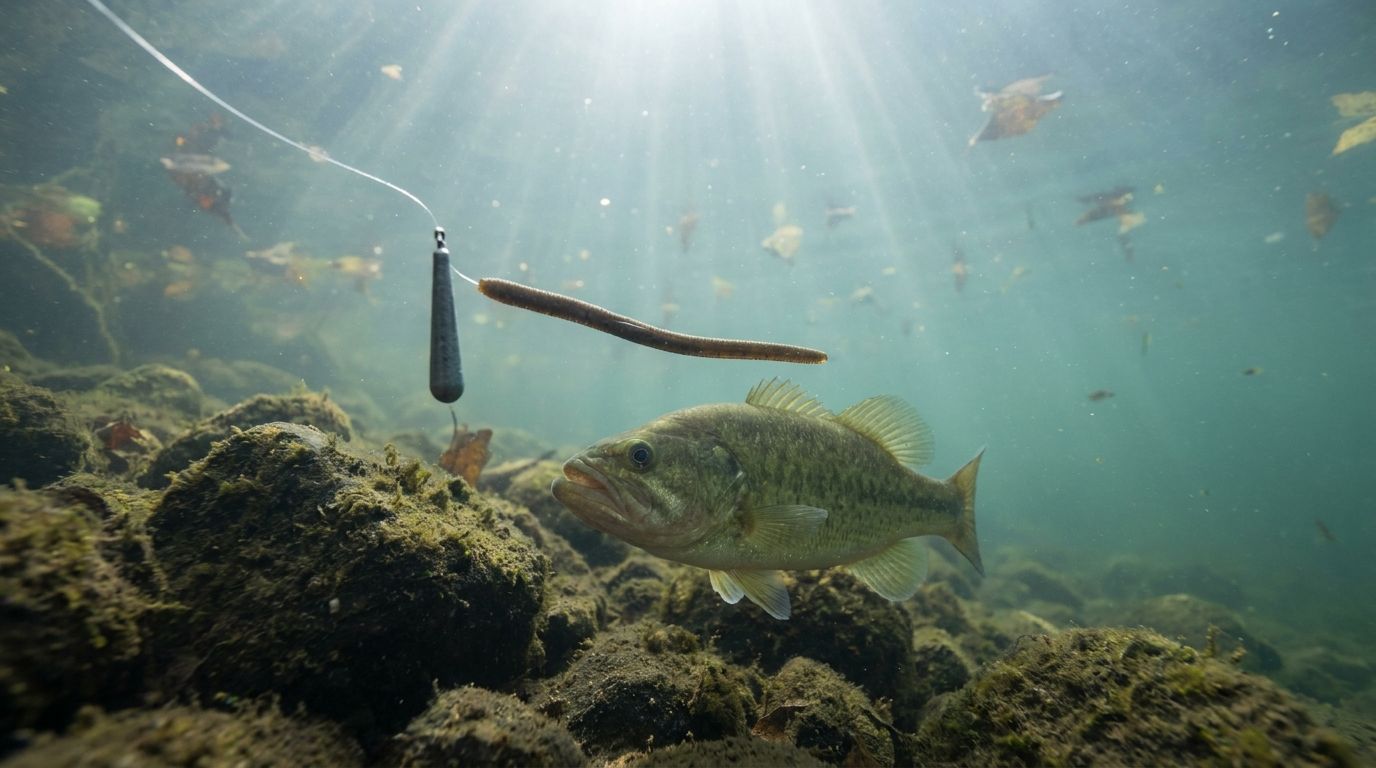
Why the Drop Shot Rules in Cold Water
No other rig keeps a bait in the strike zone as precisely as a drop shot. The weight sits on bottom. The hook and bait float at a fixed, controllable height above it — 10 inches, 14 inches, 20 inches, whatever you set. When you shake the rod tip, the bait quivers in place without moving horizontally. When you dead-stick it, it sits motionless at the exact depth the fish are holding.
That combination — precision depth, minimal movement, on-the-spot presence — is exactly what cold, slow-metabolizing bass need. They don't have to chase. The bait comes to them, stays there, and eventually becomes impossible to ignore.
In January and February on any body of water where bass are accessible, the drop shot is the technique to have rigged.
The Rig
Hook and Knot
Use a Palomar knot to tie on a drop-shot hook (Gamakatsu Drop Shot Hook or VMC Neko Hook, size 1 or 2). Leave an 18–24 inch tag end below the knot for the weight. The Palomar knot positions the hook perpendicular to the line — critical for the bait to stand at the right angle.
Thread the tag end through the hook eye from the top to maintain the correct hook angle.
Weight
A cylindrical or teardrop drop-shot weight clips onto the tag end with a swivel or line lock. Size:
- 3/16 oz: calm water, 10–18 feet
- 1/4 oz: moderate depth, 15–25 feet, or light current
- 3/8 oz: deeper than 25 feet or noticeable current
The weight should be heavy enough to maintain bottom contact without too much bow in the line. A bow means you can't feel bites.
Leader Length (Hook-to-Weight Distance)
This matters more than most anglers realize.
- 10–12 inches: Fish are tight to bottom; standard largemouth winter position
- 14–18 inches: Bass slightly elevated off bottom, which is common on ledges and bluff walls
- 20–24 inches: Fish suspended higher; visible on sonar as mid-water marks
Adjust leader length based on where you're seeing fish on your sonar. If marks are showing 3 feet off bottom, you need a longer leader.
Bait Selection
In cold water, smaller and more natural is almost always better:
- 3.5–4 inch straight worm: The classic. Finesse worms in light green pumpkin or natural shad-clear work in clear water.
- Small craw (Z-Man TRD CrawZ): (/products/z-man-trd-crawz) Floats the tail up naturally. Excellent on rocky bottom where crawfish are present.
- 3 inch finesse swimbait: Adds subtle swimming action when bass want slightly more movement, typical at 48°F+.
- 2.75–3 inch creature bait: More bulk, more water displacement. Good in stained or slightly deeper water.
For the most pressured, clear-water conditions: stick to natural colors and smaller profiles.
The Presentation
Vertical Drop Shot (Reservoir Deep-Water)
Position the boat directly over marked fish on sonar.
The key is the dead-stick phase. Cold bass often watch the shaking bait and hit during the pause. Watch the line for any movement during dead-stick periods.
Swimming the Drop Shot (Transition Zones)
On points and ledges where bass are spread along a break:
This covers water better than vertical drop shotting and works when bass are in transition between deep and shallow, typical of warmer winter days.
Gear
- Rod: 7'1"–7'3" medium-light to medium spinning rod with a sensitive tip and solid backbone for the hookset
- Reel: 2500–3000 series spinning reel
- Main line: 8–10 lb braid — the low stretch braid transmits bites and shakes from depth far better than mono or fluoro as main line
- Leader: 6–8 lb fluorocarbon, 18–24 inches, connected to braid with an Alberto or double-uni knot
The braid-to-fluoro combination is not optional in cold, clear water. Pure fluoro from the reel works, but you lose bite detection at 30 feet. Braid reads every tick.
Cold-Front Adjustment
After a severe cold front, extend all pauses. Fish that were hitting during a 5-second dead-stick may need 20–30 seconds after a front. Scale down the bait if necessary — from a 4-inch worm to a 3-inch, from a standard-action worm to a straight finesse worm with no action. Keep the bait in the zone longer.
Pairing with Other Techniques
The drop shot doesn't replace the jigging spoon or blade bait — it complements them. When vertical jigging isn't triggering strikes from marked fish, switch to the drop shot and dead-stick over the same marks. Often the fish that won't react to the blade bait's flutter will pick up the drop-shot worm.
See also Jigging Spoons for Bass and Blade Baits for Winter Bass for the full winter vertical presentation toolkit.
For complete cold-water systems, the Offshore Deep Shad Kit covers the lures for deep-water winter and the Fish Finder tool helps match technique to conditions.
Drop shot technique deep-dive at Wired2Fish.