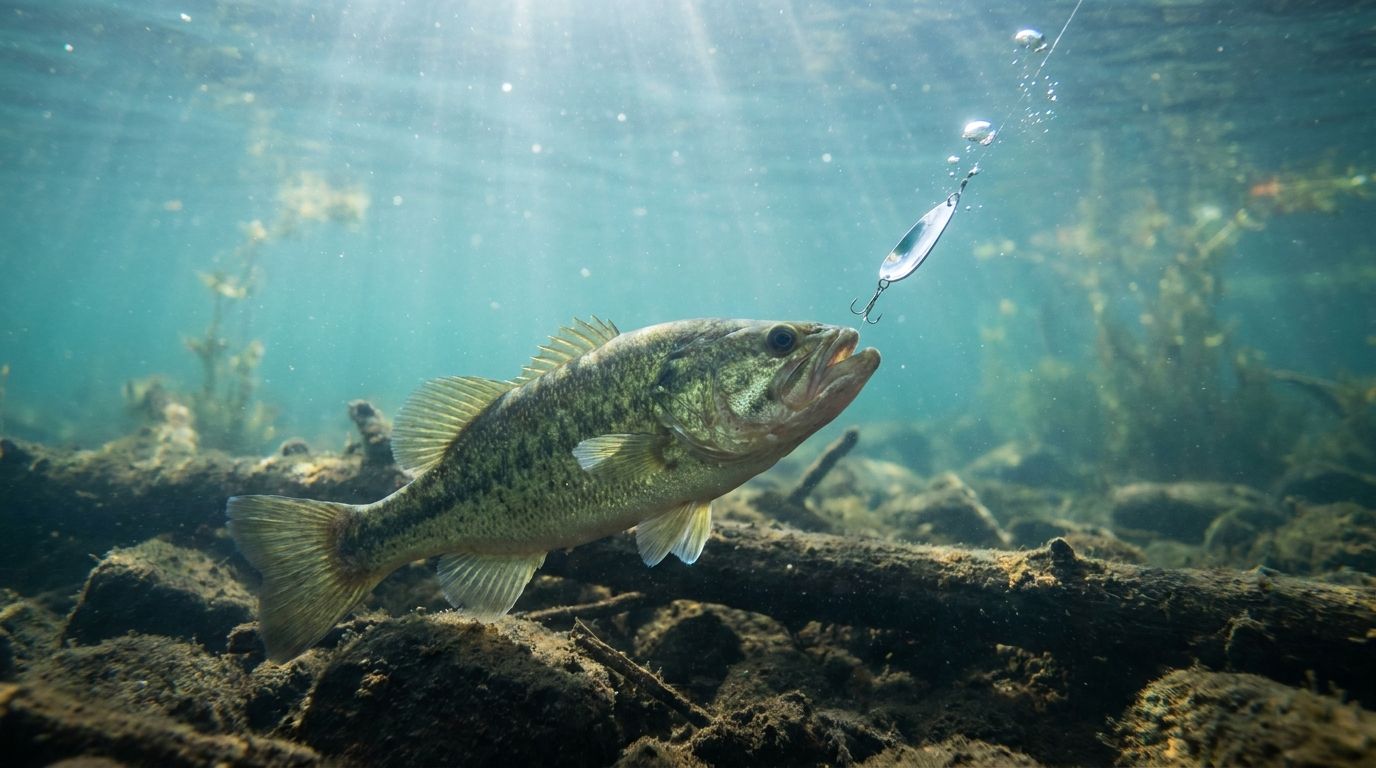
The Overlooked Technique
Ask twenty bass anglers if they fish jigging spoons. Maybe two will say yes. That ratio is a gift for those two — they're catching fish that the other eighteen are leaving behind.
The jigging spoon excels in two situations most anglers find difficult: winter deep-water bass and summer schooling bass. In both cases, the spoon gets to the fish quickly, triggers reflex strikes from fish that won't chase horizontal presentations, and can be fished precisely at any depth.
The reason more anglers don't fish spoons is that the technique feels simple to the point of seeming ineffective. It's not flashy. You're just dropping a metal lure to the bottom and lifting it up. But that simplicity is exactly the point — in cold water, complicated presentations fail, and the spoon's straightforward action is what triggers strikes.
What a Jigging Spoon Is
A jigging spoon is a dense, concave metal lure — typically 3/4 to 1.5 oz — with a treble hook attached to the bottom. The concave shape causes it to wobble, flutter, and flash on the fall. On the lift, it rises in a tight, darting motion. On the fall, it helicopters or flutters, catching light and vibrating.
That flutter on the fall is the trigger. It mimics a dying or disoriented shad exactly — a flash of silver tumbling through the water column. Bass that have been watching shad die in cold water all fall and winter respond instinctively.
When to Fish a Jigging Spoon
Winter (38°F–52°F): The primary season. Bass stacked on deep main-lake structure — points, humps, bluff walls — in 25–50 feet are prime jigging spoon targets. Use electronics to mark fish, position directly over them, and drop the spoon to their depth. The spoon goes to the fish; you're not asking them to chase.
Summer schooling: When bass are busting shad at the surface or visible on sonar chasing suspended baitfish in offshore schools, a jigging spoon dropped through the school catches fish when nothing else will. Cast past the boil, let it sink to the depth of the school, and jig it up through.
Post-cold-front: After a severe cold front when bass have moved deep and won't chase, a spoon fished vertically over marked fish can produce when jerkbaits and crankbaits can't.
How to Fish It
Vertical Jigging (Winter Primary)
The key is the controlled fall. If you reel down on a tight line, you kill the flutter. The line should be slightly slack on the drop, letting the spoon wobble and flash naturally.
Fan Casting for Schooling Bass
When bass are blowing up on baitfish schools:
Gear Setup
- Rod: 7'0"–7'6" medium-heavy baitcaster with a moderate tip — enough backbone to drive treble hooks but enough flex to prevent pulling them out of a fish's mouth
- Reel: Low-gear baitcaster (5.4:1 to 6.3:1) for power on the hookset
- Line: 15–20 lb fluorocarbon or 30 lb braid with a 15 lb fluoro leader
- Knot: Snap or split ring to the spoon's line tie — this allows free movement and better flutter
Spoon Sizes
| Depth / Situation | Spoon Weight |
|-------------------|-------------|
| 15–25 feet | 3/4 oz |
| 25–40 feet | 1 oz |
| 40+ feet or strong wind | 1.5 oz |
| Shallow schooling | 1/2 oz |
In wind or current, go heavier to maintain contact with the spoon. A spoon that blows away from directly under you loses effectiveness.
Color Selection
- Chrome/silver: The default. Matches shad perfectly in clear to moderately stained water.
- Gold: Warmer water or stained conditions. Also effective in low light.
- White: When shad are very pale (cold water kills pigment).
Common Mistakes
Fishing on a tight line on the fall. The flutter only happens on slack line. Let the spoon fall — keep the line barely taut.
Not using electronics. A jigging spoon fished without knowing where the fish are is random. Find them first.
Setting the hook too hard. Treble hooks require a firm sweep, not a power slam. Over-driving buries the hooks but can also straighten them on big fish.
Moving the spoon too fast. In winter especially, slow down the lift. Two feet of lift per second is often too fast. One foot per second, with a pause at top and bottom, is better.
For deep-water winter fishing using multiple techniques together, see How to Find and Catch Bass in Deep Winter Reservoirs. For the drop shot alternative when fish won't respond to the spoon, Drop Shot in Cold Water covers the finesse side.
The Offshore Deep Shad Kit pairs well with jigging spoon work for complete deep-water coverage.
In-depth jigging spoon technique at Wired2Fish and Bassmaster.