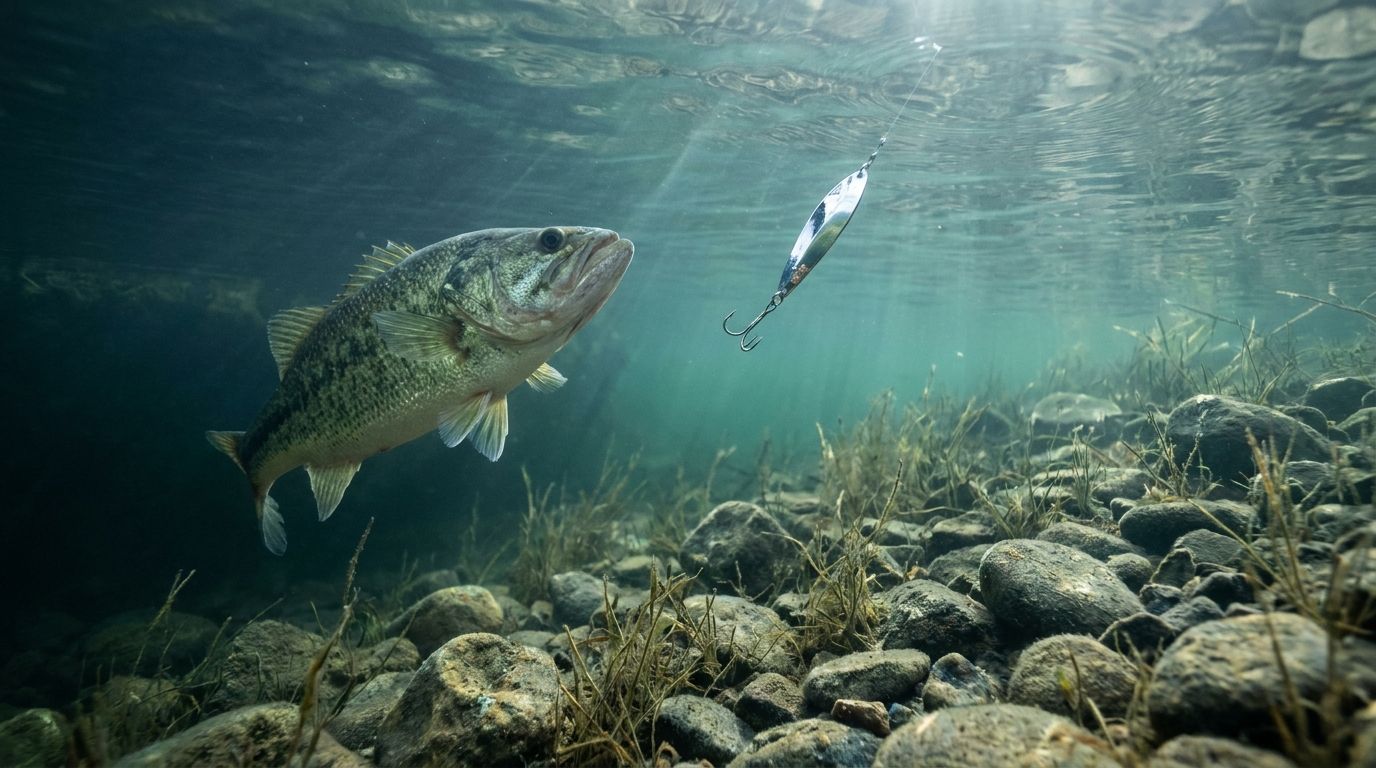
What Makes Blade Baits Different
Most winter bass anglers default to jerkbaits or finesse rigs. Blade baits occupy a different niche — they get deep fast, they vibrate intensely, and they can be worked vertically right on top of fish that electronics reveal.
A blade bait is a dense, flat metal lure with a treble hook at each end. When you lift and drop it, the blade kicks left or right and vibrates on the fall. That vibration in cold, clear water creates a flash-and-thump that triggers cold bass that won't chase horizontal presentations.
The technique is particularly effective on impoundments where bass stack on main-lake structure — points, humps, channel edges — in 20–45 feet of water. If you're not using a blade bait in those conditions, you're likely leaving fish behind.
Reading Your Electronics for Blade Bait Targets
Blade baits are a vertical presentation. That means they shine when you can position directly over fish.
What to look for on your sonar:
- Hard marks tight to bottom — these are classic winter bass positions, often on the steep side of a point or the base of a bluff
- Fish suspended 2–10 feet off bottom — bass that won't commit to a horizontal bait will often hit a blade dropped to their eye level
- Arching returns on structure transitions — the point where a flat meets a drop is a prime location
When you find marks on a main-lake point in 25–35 feet, idle over them slowly, mark the position, then back off and drop the blade.
The Vertical Blade Bait Technique
The lift-drop is the core retrieve, but execution matters.
Step 1: Drop to the target depth
Free-spool to bottom, then reel up to where you're marking fish. If they're at 22 feet on a 28-foot bottom, drop to 26 and work up through the zone.
Step 2: The lift
Raise your rod tip sharply — not a sweep, a quick pop — about 12–18 inches. This causes the blade to shoot upward and flutter.
Step 3: The controlled fall
Lower the rod at the same rate the bait sinks. Keep a semi-slack line. The bait should vibrate on the drop, not fall on a tight line. Most strikes come on the fall.
Step 4: Pause
In water colder than 45°F, add a 2–3 second pause at the bottom before lifting again. Bass often follow and then hit a stationary bait.
Strikes feel like a tick or a sudden weight. Set the hook with an upward sweep — treble hooks don't need a violent hookset.
Gear for Blade Baits
- Rod: 7'0" medium-heavy spinning or baitcaster with a moderate-fast tip — too stiff and you'll tear hooks, too soft and you'll miss fish
- Line: 10–14 lb fluorocarbon, or braid with a 12 lb fluoro leader for depth sensitivity
- Snap: Always use a snap, not a knot — knots on the attachment ring kill the bait's action
Blade sizes to carry:
- 1/2 oz for 15–25 feet
- 3/4 oz for 25–40 feet
- 1 oz for deeper than 40 feet or strong current
Best Colors and Situations
| Situation | Blade Color |
|-----------|-------------|
| Clear water, sunny | Chrome/silver |
| Stained water | Gold |
| Low light, overcast | Gold with orange belly |
| Post cold front, clear | Chrome |
Blade baits produce best in temperatures from 38°F to 50°F. Below 38°F, the drop cadence slows further and jigging spoons often outperform. For that cold-water arsenal, see our guide on Jigging Spoons for Bass.
Making the Most of Blade Baits on Reservoirs
Winter reservoir bass are predictable. Find the deepest adjacent structure to known spawning coves and you'll find fish. For a full breakdown of how bass use deep structure in winter, read the Fall Reservoir Deep Guide — the same structure that holds bass in late fall holds them through winter.
The Strike King Red Eye Shad (/products/red-eye-shad) is technically a lipless crankbait, but it shares many properties with blade baits and can be yo-yo'd vertically the same way. Many winter anglers fish both in the same session depending on whether fish are actively feeding or just holding.
More winter bass technique breakdowns at In-Fisherman and Bassmaster.