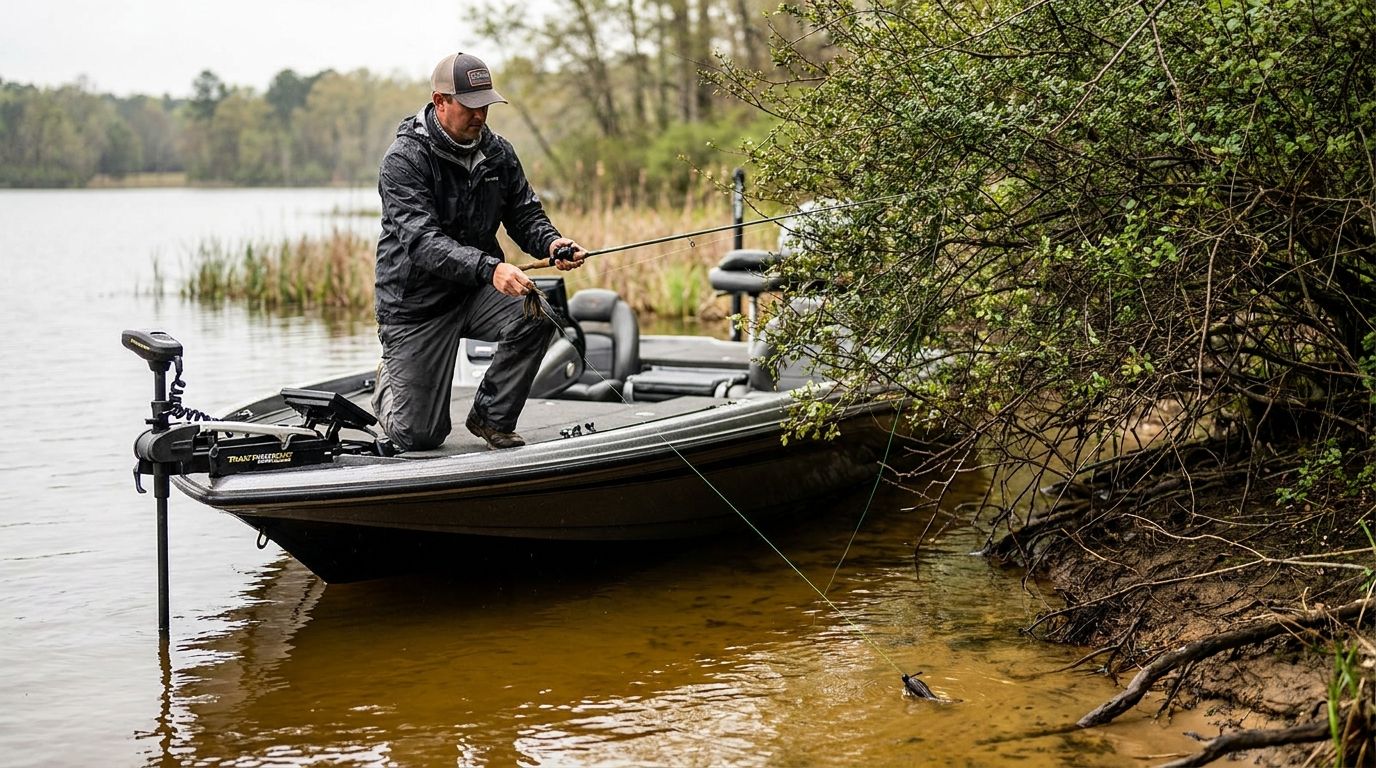
When Flipping and Pitching Matter Most
Bass in spring move into shallow cover — docks, laydowns, flooded brush, standing timber, boat ramp pilings, willow branches dragging in the water. They use this cover for both staging and spawning. The fish are there; the problem is reaching them without spooking them.
Standard casting places the lure 30–60 feet away. Flipping and pitching reduce that distance to 10–20 feet and allow for accuracy within inches. You can drop a jig through a 6-inch gap in dock boards, pitch to a root ball at a laydown, or flip to a mat edge with repeatable precision.
These techniques are most productive from pre-spawn through early post-spawn — roughly March through May in most of the country.
Flipping vs. Pitching: The Difference
Both techniques deliver lures accurately at short range. The mechanics differ.
Flipping:
- Works at distances of 8–15 feet
- Line is pulled through the guides and held out at a length equal to the target distance
- The lure swings like a pendulum — lowered, swung back, swung forward, and released into the target
- Extremely quiet entry — the lure barely disturbs the water surface
- Best for: maximum-stealth presentations within 15 feet
- Works at distances of 15–40 feet
- Lure is held in the off-hand, rod tip pointed forward
- The rod tip drops and the lure is lobbed underhand — an arc trajectory
- Accurate to about baseball-accuracy at 30 feet with practice
- Best for: reaching targets that require more distance than flipping allows
Most anglers flip close and pitch medium distances. Both should be learned because different cover types demand different approaches.
Gear for Flipping and Pitching
Rod: 7'3"–7'11" heavy or extra-heavy baitcaster, fast to extra-fast action. You need leverage to pull fish from heavy cover, and length helps with pendulum flip mechanics.
Reel: High-speed baitcaster (7.5:1–8.1:1). You need to pick up slack line fast when a fish runs toward you.
Line: 50–65 lb braided line directly tied to the lure in heavy cover. In lighter cover or clearer water, 20–25 lb fluorocarbon. Braid cuts through weeds; fluorocarbon is more invisible.
Lures: Most flipping is done with jigs (3/8 to 1 oz depending on cover density) or Texas-rigged soft plastics with a pegged tungsten sinker (1/4 to 1 oz). The heavier the cover, the heavier the sinker — you need the bait to penetrate.
Target Selection: Not Every Piece of Cover Is Equal
The mistake beginners make: flipping every dock, every bush, every laydown. This burns time and spooks fish on lower-quality targets.
Quality flipping targets in spring:
Docks: Not all docks equally. Floating docks with shade, adjacent to 5–8 feet of water in or near spawning coves, are prime. Fixed-post docks in 2–3 feet are also productive. The back corners and center supports are better than the front.
Laydowns: Trees or branches that fell into the water with the majority of the structure extending into 4–8 feet. The root ball and the deepest part of the tree — where multiple branches create complex cover — hold the most fish.
Flooded bushes and willows: In post-rain, elevated water conditions, new flood cover concentrates bass quickly. Willows growing along the bank with limbs dragging in the water are classic early-spring bass cover.
Boat dock pilings: Often overlooked. A dock with 4–6 round pilings gives multiple targets. The shaded, deepest piling is usually best.
Isolated heavy cover: A single bush or fallen tree on an otherwise bare flat is worth multiple casts — isolation concentrates fish.
The Flip and What Happens Next
The pause matters. Bass in cover often watch a bait fall and strike when it hits bottom. Don't move it immediately — give it 5–10 seconds.
Hookset
In heavy cover, use a powerful hookset. When you feel a bite, drop the rod tip slightly to take in slack, then drive the hook with a hard upward or horizontal sweep. In 65 lb braid with a heavy hook, you need to drive the hook through the plastic and into the fish's jaw.
Immediately after the hookset: pull the fish out of the cover before it wraps around structure. Lift aggressively, steer with the trolling motor if needed. A bass in a laydown that gets around a branch is often a lost fish.
For More Spring Techniques
Flipping and pitching pair naturally with the bed-fishing approach described in Bed Fishing for Bass. The cover adjacent to bedding flats — docks, timber, brush — is primary territory for these techniques.
For vegetation-specific pitching in spring grass, see Bass in Shallow Grass. The Bluegill Cover Kit includes lures designed for pitching into heavy cover — with the right hooks and weights for the technique.
More on flipping and pitching from Wired2Fish — they cover the mechanics in video detail that complements this written guide.