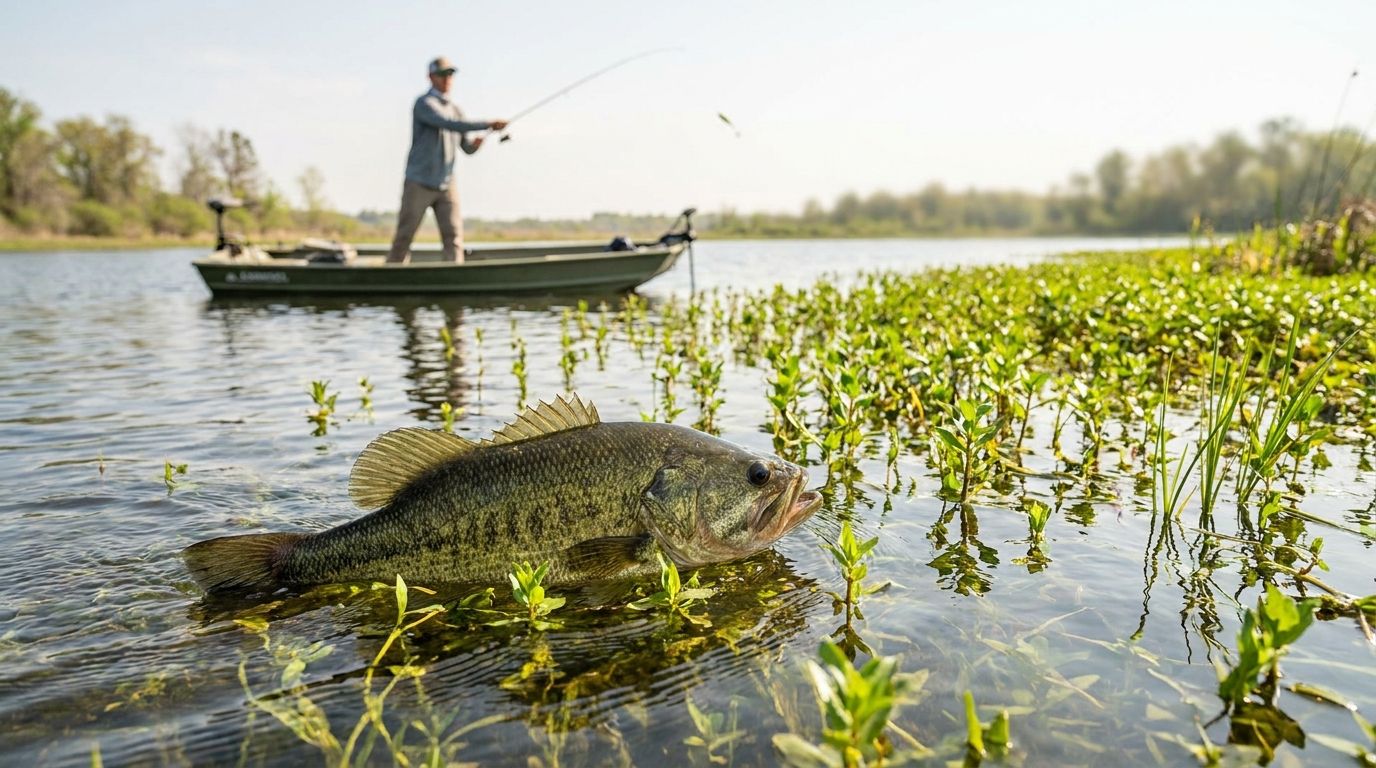
Why Grass Matters in Spring
Vegetation growth in spring creates productive bass habitat almost from scratch. A flat that had no significant grass in January may have 2 feet of emergent milfoil, hydrilla, or coontail by April — and bass will be in it immediately.
Grass provides cover, oxygen, feeding structure, and ambush points. Spawning bass use vegetation to conceal beds. Post-spawn bass use it as primary feeding habitat. Early-summer bass move into deepening grass edges as the growing season advances.
Understanding which grass is worth fishing, and which technique each situation demands, separates productive anglers from those randomly casting at any green thing.
Grass Types and What They Mean
Milfoil (Eurasian and native): Grows in dense mats in 2–10 feet. Spreads quickly in nutrient-rich water. Creates excellent bass habitat but can be so thick it's unfishable with anything except punch rigs. Focus on the edges, openings, and irregular features.
Hydrilla: Similar to milfoil but grows even denser. Can cover the entire bottom of a flat from 1 to 15 feet. Bass relate to hydrilla edges and the tops where the growth approaches the surface. On southern lakes with year-round hydrilla (Lake Guntersville, Sam Rayburn, Toho), this is the primary habitat type.
Coontail: Forms circular masses in 3–8 feet. Often has isolated pockets and open edges. Less dense than hydrilla — more fishable with conventional baits that would foul in hydrilla.
Cattails and emergent reed: Shallow vegetation in 0–3 feet. Bass spawn adjacent to cattail lines and use it as ambush cover. Works well for flipping and pitching, frog fishing along edges.
Lily pads: Classic spring bass cover. Pads emerge in spring from rhizomes and quickly create a canopy over shallow areas. Bass bed under them and use them as summer cover. Frogs and hollow-body lures for fishing on top; weedless soft plastics for fishing through gaps.
Identifying Productive Grass
Not all spring grass holds fish. The productive edges share these characteristics:
Depth transition: The outside edge where grass meets open water is almost always more productive than the interior. Fish use this edge as both ambush zone and travel route.
Irregular features: A point on a grass edge, a pocket or opening in the mat, a clump of coontail isolated from the main grass — any irregularity concentrates bass. Fish the irregularities before the straight sections.
Current or wind exposure: Grass edges receiving current or consistent wind often hold more active fish because oxygenation is higher and baitfish concentrate near the movement.
Adjacent to spawning habitat: Spring grass that's near (or in) spawning coves holds pre-spawn and post-spawn fish in addition to spawning fish.
Techniques by Grass Situation
Open Grass Edges (Milfoil, Coontail Exterior)
Swim jig: The premier open-grass-edge technique in spring. A 3/8 oz swim jig with a paddle-tail trailer, retrieved along the grass edge at 3–5 feet, catches fish in both pre-spawn and post-spawn phases. See Swimming Jigs for Post-Spawn Bass.
Chatterbait: Along the same edges, a chatterbait (bladed jig) retrieved at moderate speed creates vibration and flash that triggers strikes from active fish. Works best when bass are feeding aggressively (post-front recovery, active feeding windows).
Crankbait: A mid-depth crankbait deflected off the grass edge produces reaction strikes. Run it parallel to the edge and let it make contact periodically. The Rapala DT4 Bluegill (/products/dt4-bluegill) running 4 feet is ideal for shallow grass-edge cranking.
Matted Vegetation (Hydrilla, Milfoil Mats)
Texas rig (heavy weight): A 1/2 to 1 oz tungsten bullet weight pegged directly to the hook, with a creature bait or worm, penetrates into the mat and drops into the pocket below. This is the standard approach for matted grass.
Punch rig: Even heavier tungsten (1 to 1.5 oz) with a tungsten punching sinker, designed to drive through the mat canopy. For the thickest grass that a standard Texas rig can't penetrate. See Punching Matted Vegetation for the full breakdown.
Hollow-body frog: Walk across the mat and work it into openings. Bass explode through the mat surface on frog bites — one of the most visceral strikes in bass fishing. Full frog technique at Frog Fishing Guide.
Emergent Vegetation (Cattails, Reeds, Lily Pads)
Flipping and pitching: The primary approach. Pitch or flip a jig or Texas-rigged creature bait into pockets and along the inside edge of emergent vegetation. See Flipping and Pitching Shallow Cover.
Frog on lily pads: Walk a hollow-body frog across pad fields. Target pad edges, openings between pads, and any surface disturbance from feeding fish.
Grass Color and Water Clarity
Stained water over grass: chartreuse, white, dark colors with strong contrast
Clear water over grass: natural green pumpkin, watermelon, brown/orange
Bass in clear-water grass can see your bait from a distance and are more wary. Natural colors outperform bright ones in clear, pressured grass.
The Bluegill Cover Kit is assembled for shallow grass fishing — weedless presentations with the right color profiles for spring vegetation bass. For the forage context, see Best Bass Forage by Lake Type.
More grass fishing technique at Bassmaster and Wired2Fish.