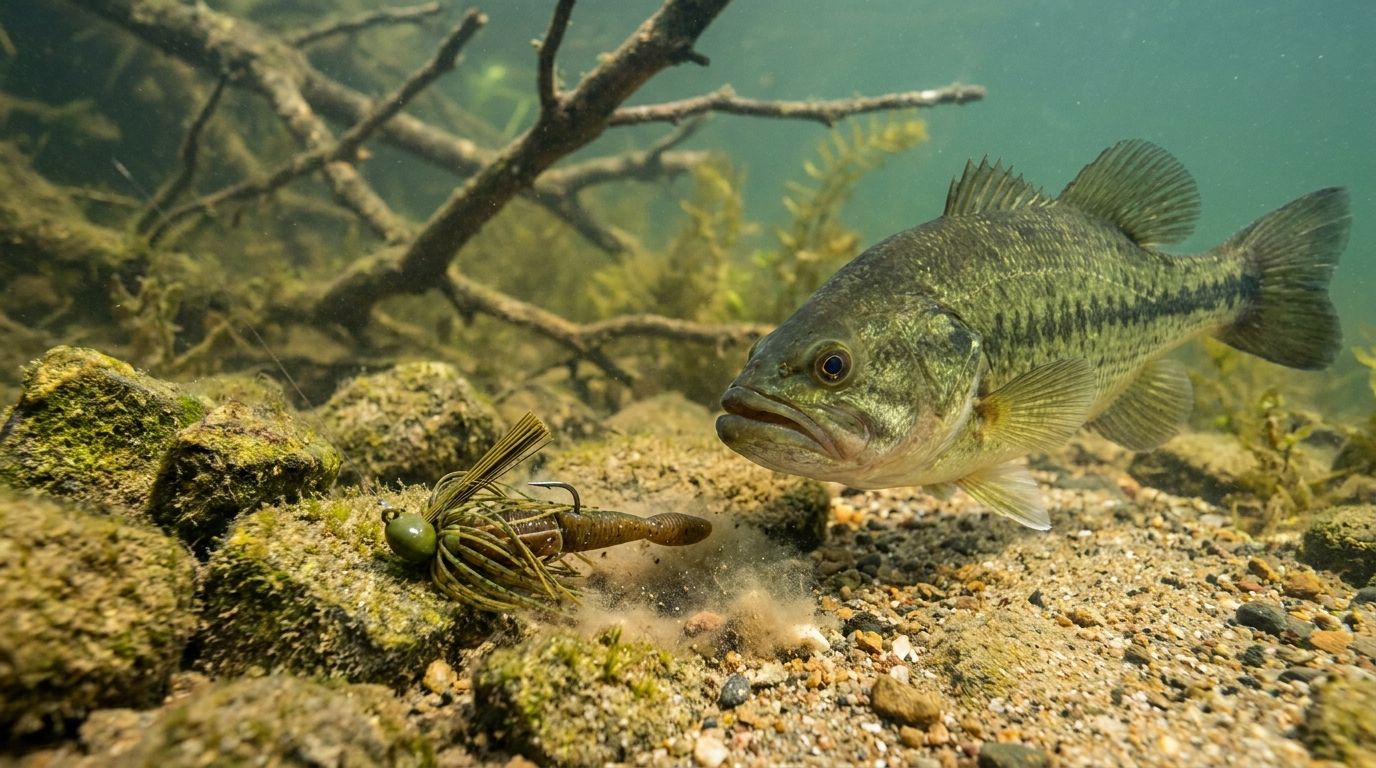
Why Jigs Dominate Pre-Spawn Fishing
The jig is probably the most debated lure in bass fishing — too many styles, weights, trailers, and techniques. Pre-spawn simplifies the decision: a medium-weight jig with a craw trailer, fished slowly on bottom, catches more big fish in February and March than nearly any other lure.
The reason is direct forage matching. Pre-spawn bass on their way to spawning flats are following active crawfish. Crawfish become mobile when water temperatures rise into the mid-40s, and rocky or hard-bottom staging areas concentrate both prey and predator. A dragged jig that looks like a slowly-moving crawfish gets eaten because it looks like food that bass have been hunting.
Jig Selection for Pre-Spawn
Weight:
- 3/8 oz: The standard for most pre-spawn situations — 8–15 feet, normal wind
- 1/2 oz: Deeper staging areas (15–20 feet), windy days, stronger current in rivers
- 5/16 oz: Calm days, shallow staging areas, clearest water — less splash on entry
- Football head: Hard, flat bottom in open water. The flat head rocks and rolls on retrieve, presenting the trailer claw-up. Excellent on gravel and rock flats.
- Arkie/round head: Versatile, appropriate for most situations. Works around light cover and over varying bottom types.
- Swim jig head (flatter, more streamlined): When you're slow-rolling rather than dragging — the head doesn't snag vegetation as easily.
Pre-spawn calls for natural crawfish colors — brown, green pumpkin, dark green. Dark blue/black on overcast days or in stained water. Stay away from bright colors until water warms above 58°F and fish become more aggressive.
Trailer Pairing
The trailer changes the profile and action significantly.
Compact craw (2.5–3 inch): Best in clear water and cold water (below 50°F). Smaller profile, less action, more natural. Googan Krackin' Craw (/products/googan-krackin-craw) trimmed at the claws works well.
Full-size craw (3.5–4 inch): Warmer water (50°F+), stained water, or when you want maximum bulk. More water displacement, more visual profile.
Chunk trailer: A solid chunk trailer (no appendages) creates a bulky, slow-falling presentation with minimal action. Effective on very cold days when bass don't want to see any movement.
Small paddle-tail: When fish want slightly more action — warmer days in March — a small paddle-tail trailer gives the jig a swimming motion on slow-roll retrieve.
The Core Retrieve: Drag and Pause
The slow drag is the foundation of pre-spawn jig fishing. It's not exciting to execute, but it's consistently the most effective retrieve in water below 58°F.
Execution:
The pause after each drag is essential. During the pause, the skirt flares and settles, the claw trailer slowly drops back down, and the jig looks exactly like a crawfish settling after fleeing. Bass eat it in this moment.
In water below 48°F, extend pauses to 8–10 seconds. The colder the water, the longer the pause.
The Slow-Roll
When bass are slightly more active — staging areas at 52°F+ on sunny afternoons — the slow-roll retrieve produces big fish by covering more water.
Cast to a secondary point or along the face of a bluff. Retrieve with the rod tip low, keeping the jig barely above bottom with a slow, steady retrieve. The jig rolls along bottom, occasionally bumping structure. Speed should be the minimum that keeps the jig moving and the skirt pulsing.
The slow-roll covers the staging structure more efficiently than a drag, making it better for searching. When you get a bite, slow down further or switch to drag on that specific spot.
Line and Rod Setup
- Rod: 7'0"–7'4" medium-heavy baitcaster, fast to extra-fast action. Sensitivity for bite detection through the rod blank; backbone for long hooksets on the pause.
- Reel: Baitcaster, 7.1:1 recommended — faster for picking up slack line
- Line: 15 lb fluorocarbon in clear water. 20 lb fluorocarbon or 30 lb braid in stained water or around cover. No leader needed — tie directly.
Recognizing the Bite
Pre-spawn jig bites range from aggressive thumps (feeding fish) to barely-perceptible weight changes (cold, suspicious fish). What to watch for:
- Line moving sideways during the pause — bass picked up the jig and moved
- Sudden slack on the drop — fish swam up and took the jig
- "Tick" as the jig is falling on the initial cast — fish intercepted it in the water column
- Rod tip loading up at the end of a drag when you thought nothing was there
Keep the line slightly taut during pauses. Watch where it enters the water. Any lateral movement that you didn't cause is a bite.
For the complete staging area picture, see Finding Pre-Spawn Staging Areas. The Prespawn Craw Kit and Jig + Craw Trailer Kit cover the lure systems needed for this pattern.
Pre-spawn jig technique from tournament pros at Bassmaster and Wired2Fish.