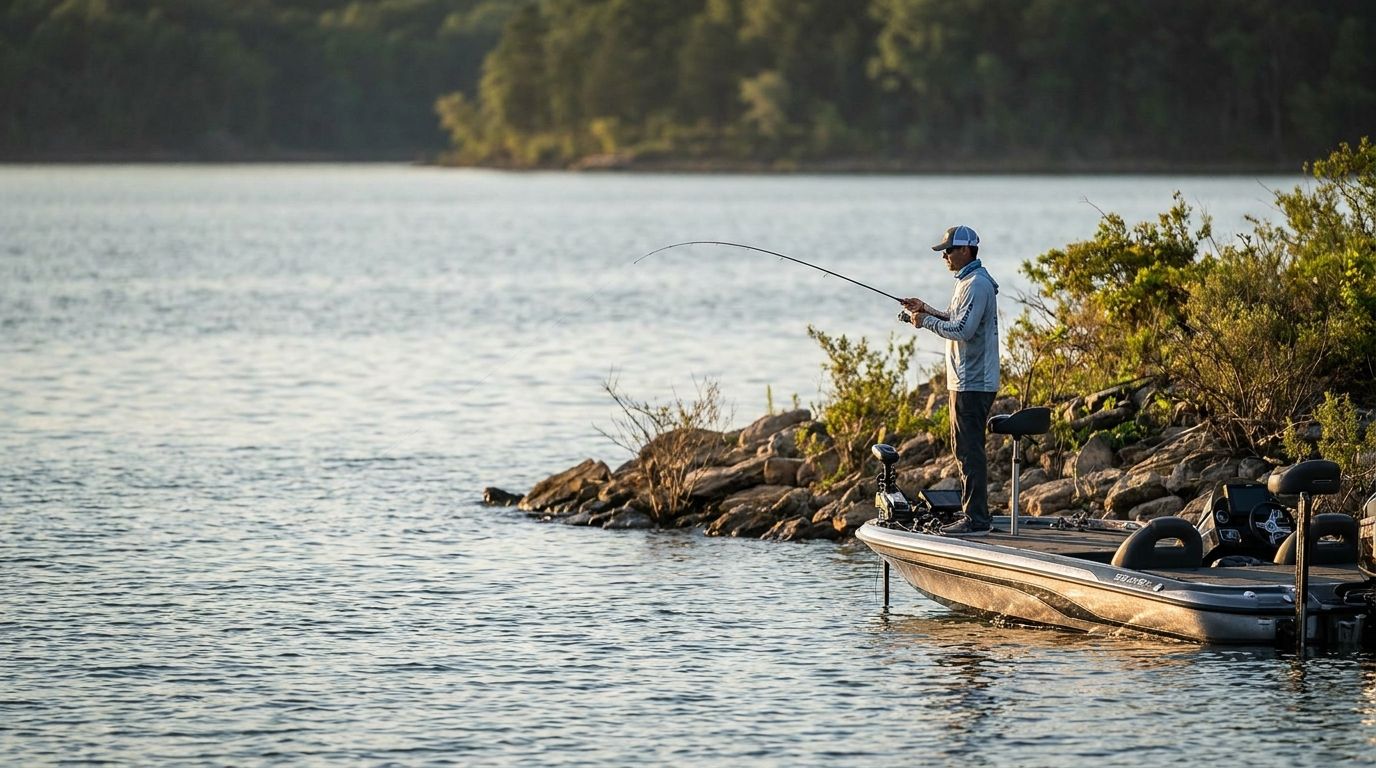
Why Main-Lake Points Are Summer Magnets
Main-lake points are the intersection of everything bass need in summer: access to deep water, proximity to open-water shad schools, hard bottom that holds temperature better than soft mud, and defined structure that bass use as a reference point throughout their daily movements.
A bass living on a main-lake point in early summer has the best of both worlds. It can move 15 feet deeper to find cooler water and suspended baitfish. It can move 8 feet shallower to ambush feeding opportunities on the flat top of the point. It can hold at the tip where current (if any) concentrates prey. Everything it needs is within a short swim.
This is why main-lake points — especially those with the right depth profile and bottom composition — hold bass reliably from the end of the spawn through the first cold fronts of fall.
What Makes a Point Productive
Not all points are equal. The productive ones share several characteristics:
Defined depth change. A point that slopes gradually from 5 to 15 feet over 200 yards is less productive than one that breaks from 8 to 25 feet over 50 yards. The sharper the break, the more fish concentrate on it.
Hard bottom. Gravel, chunk rock, shell, or compacted clay on the point face holds bass better than mud or silt. See Reading Bottom Composition to Find Winter Bass — the same principles apply in summer.
Main-lake access. Points on primary creek arms rather than deep secondary coves hold more fish in summer because they have better access to open-water baitfish schools. The points where the main lake meets the mouths of major creek arms are particularly productive.
Brush or rock feature on the point face. Any isolated cover element on an otherwise bare point concentrates fish specifically. An isolated rock pile at 22 feet on the face of a main-lake point is a waypoint worth returning to every summer.
Orientation to current. On TVA and other reservoirs with consistent generation current, points that deflect current and create downstream eddies hold more fish in generation conditions.
Using Electronics on Points
You cannot fish summer main-lake points effectively without knowing where the fish are. Before fishing a point:
Fish at 18 feet on a point that has a break at 20 feet? You're fishing a football jig along the slope. Fish suspended 8 feet off the bottom in 28 feet of water? Drop shot or jigging spoon.
Presentations by Depth
Shallow (8–15 feet): Crankbait and Football Jig
A mid-depth crankbait like the 6th Sense Cloud 9 C10 (/products/cloud-9-c10) or Crush 300DD (/products/crush-300dd) reaching 8–12 feet is highly effective on the upper break of a main-lake point in early summer. The bass are active, the depth is reachable, and the deflection action of a crankbait bumping structure triggers reaction strikes.
A football jig dragged along the 10–15 foot contour — the classic ledge-fishing technique — is the most consistent presentation for points where bass are sitting tight to bottom.
Mid-Depth (15–22 feet): Football Jig and Carolina Rig
The football jig is specifically designed for this depth range on hard, open bottom. It rolls and wobbles as it's dragged, creating a distinct action that bass find irresistible. Cast up the slope, reel down to the jig's depth, and drag slowly back toward deeper water.
The Carolina rig covers the same water more efficiently for searching a large point. Cast parallel to the break, drag slowly, pause at every change in bottom composition.
Deep (22–35 feet): Drop Shot and Jigging Spoon
Fish that have retreated to summer depths on the deep side of a point require vertical or near-vertical presentations. A drop shot lowered to their depth, or a jigging spoon worked over marked fish, is more effective than trying to drag a lure through 30 feet of water column.
For the full summer deep-water electronics approach, see Using Your Fish Finder to Locate Summer Bass.
Early Summer Point Patterns (April–June)
In the early summer transition, bass on main-lake points are still partially in transition from spring patterns. Two specific behaviors are common:
Following shad schools. Schooling shad move over main-lake points at specific times of day, and bass shadow them. The bite turns on and off abruptly as the school moves. When you see boils or surface activity on a point, get there fast and fish the periphery of the baitfish school.
Stacking on the break. As surface temperatures rise, bass compress into a narrow temperature comfort zone along the depth break. A thermocline establishes as summer deepens, and bass hold at or just above it. On main-lake points, this zone may be at 18–22 feet.
For how forage availability connects to these patterns, check What Bass Eat by Season and the Shad guide.
The Offshore Deep Shad Kit covers the presentations for this pattern from shallow point-fishing through deep-ledge techniques. Use the Seasonal Fishing Calendar to know when summer point patterns typically peak in your region.
Ledge and offshore fishing technique from pros at Bassmaster.