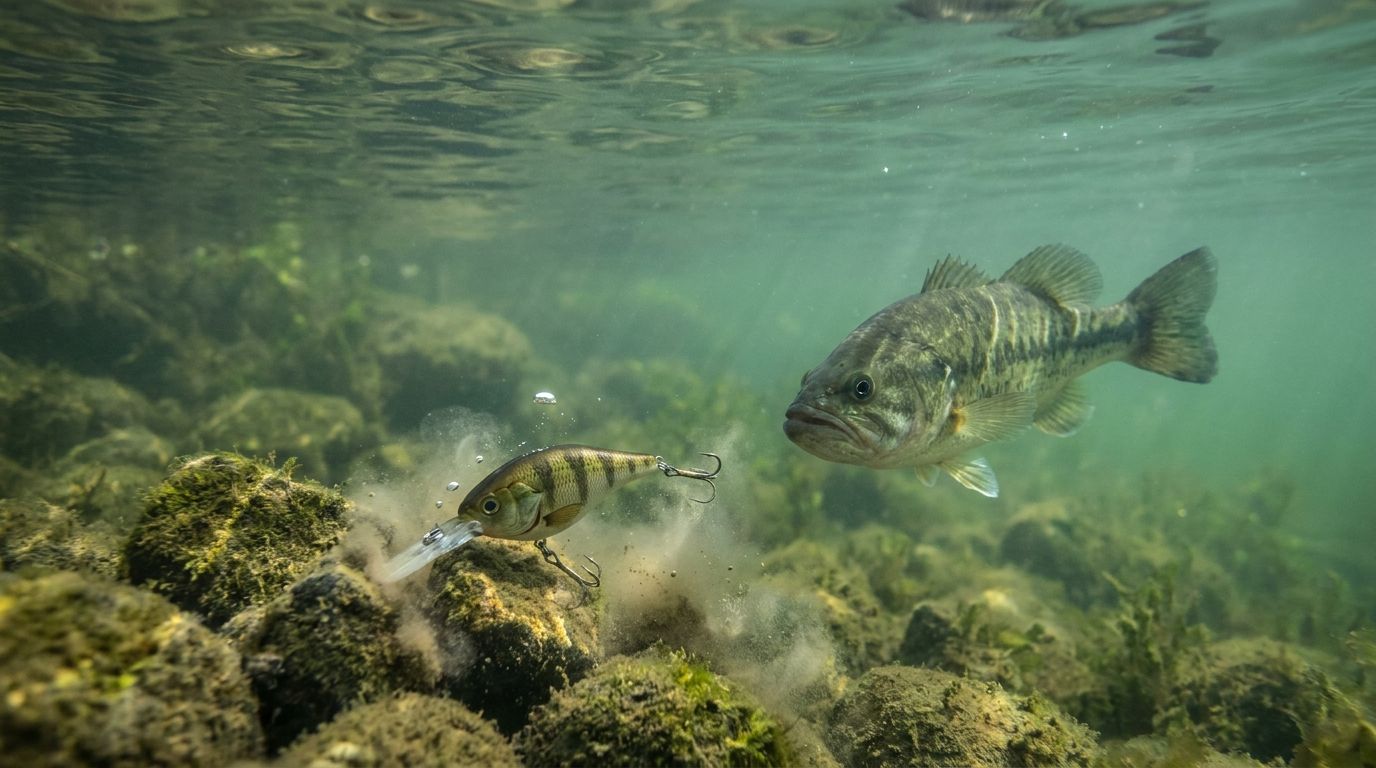
The Crankbait's Pre-Spawn Window
The crankbait transitions from cold-water struggle to prime-time producer around 52°F. Below that temperature, bass won't reliably chase a moving horizontal presentation. Above it, a crankbait covering structure efficiently is one of the most productive tools in the pre-spawn box.
The 52°F–62°F window — which aligns with the staging and pre-spawn peak phases — is crankbait country. Fish are moving, feeding, and positioned at depths a mid-diving crankbait reaches naturally.
The advantage over a jig in this range: coverage. A crankbait fished down a secondary point covers that point in 20 casts. A jig may take 60 casts to work the same area thoroughly. When fish are moving and spread across a transition zone, the crankbait finds them faster.
What "Mid-Depth" Means
Mid-depth crankbaits run 6–12 feet on a standard cast with medium-diameter line. The specific running depth depends on the bait, lip angle, and line used.
Key examples for pre-spawn:
Rapala DT6 Bluegill (/products/dt6-bluegill): Runs 6 feet. Perfect for secondary points, dock ends, and creek mouths in 8–10 feet.
6th Sense Cloud 9 C10 (/products/cloud-9-c10): Runs 8–10 feet depending on line and speed. The most versatile pre-spawn depth for most reservoir staging areas.
Rapala DT8 Bluegill (/products/dt8-bluegill): Runs 8 feet. Solid option for deeper flat edges and channel-adjacent structure.
6th Sense Crush 300DD (/products/crush-300dd): Runs 9–11 feet. Reaches staging bass on main-lake points and secondary points with depth.
Color Selection
Pre-spawn crankbait color follows the forage. In most reservoirs at this time of year, two forage types dominate: shad (still present from winter schools) and crawfish (increasingly active on rock and gravel).
| Forage / Condition | Crankbait Color |
|-------------------|----------------|
| Shad-dominant lake, clear | Sexy shad, pearl, ghost shad |
| Shad-dominant, stained | Chartreuse shad, pro blue |
| Crawfish-dominant, clear | Brown craw, natural craw |
| Crawfish-dominant, stained | Red/orange craw, dark green craw |
| Mixed forage, overcast | Chartreuse/black |
The bluegill coloration on the Rapala DT and 6th Sense models serves double duty — it reads as crawfish in dark conditions and as small bream in clear water. Both are legitimate early-spring forage.
For more on when to choose crawfish vs. shad patterns, see Bluegill vs Shad: When to Choose.
How to Fish It on Points
Standard point presentation:
The deflection off rocks, stumps, or hard bottom is the crankbait's primary trigger in pre-spawn. When the bait bounces and changes direction, it mimics a startled crawfish or minnow — bass respond reflexively.
Work both sides of a point. The productive depth contour might be on the north face in the morning (shade) and the south face in the afternoon (sun exposure). Fish the entire structure before leaving.
Retrieve Speed and Temperature
Water temperature directly affects the right retrieve speed.
| Water Temp | Retrieve Speed |
|-----------|---------------|
| 52°F–56°F | Very slow — the bait should barely wobble |
| 56°F–60°F | Moderate — steady, consistent wobble |
| 60°F–64°F | Faster — fish are aggressive, trigger strikes |
In the low-50s, many anglers fish crankbaits faster than bass want to see them. Slow the reel handle down. If the bait is chattering and wobbling, you're going the right speed. If you're reeling in line and that's it, you need to slow down.
Line and Rod Setup
Line matters more for crankbaits than most other lures.
- Monofilament or copolymer (12–15 lb): The stretch cushions the hookset and keeps hooks pinned in fish. Also allows the bait to float up slightly in the pause, reducing snags.
- Fluorocarbon (10–12 lb): Runs deeper than mono (fluoro sinks, mono floats). Better sensitivity. More snags. Use in open-structure situations.
- No braid for crankbaits — braid has zero stretch and will pull treble hooks from fish faces.
When the Crankbait Beats the Jig
Use the crankbait over the jig when:
- Water is warming and fish are actively moving (52°F+)
- You're searching a large area and haven't located fish
- Fish are reacting to deflection more than a stationary bait
- There are multiple good-looking points and you need to assess them quickly
Switch to the jig when:
- Fish are located but slow to commit
- Water cools after a cold front
- The area has too much snag risk for trebles
For the staging area location picture, see Finding Pre-Spawn Staging Areas. The Bluegill Crankbait Depth Kit covers the full depth range for pre-spawn and early spring cranking.
More on pre-spawn crankbait fishing at Wired2Fish.